




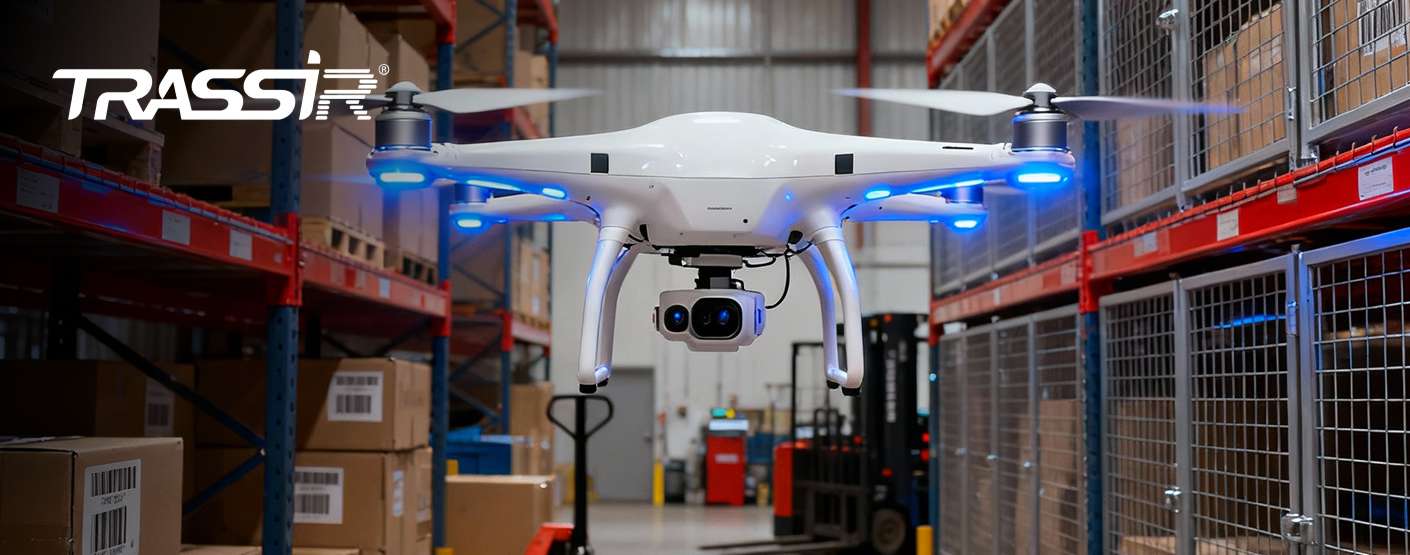
Drone Surveillance Technology: Revolutionizing Logistics Site Security
The logistics industry faces an unprecedented security crisis, with cargo theft incidents surging 49% in 2024 to reach 2,217 cases across North America, resulting in average losses of $202,000 per incident. Traditional perimeter security and static surveillance systems are proving inadequate against sophisticated criminal networks that exploit operational blind spots and leverage advanced technology for strategic theft operations. Drone surveillance technology integrated with intelligent video management systems represents a transformative solution that addresses both the scale and complexity of modern logistics security challenges.
TRASSIR, the global leader in intelligent video surveillance with over 500,000 deployed projects across 42+ countries, pioneers the integration of autonomous drone capabilities with AI-powered video analytics to create comprehensive security ecosystems for logistics facilities. This revolutionary approach transforms passive monitoring into active operational intelligence, delivering measurable security improvements while optimizing operational efficiency across distribution networks.
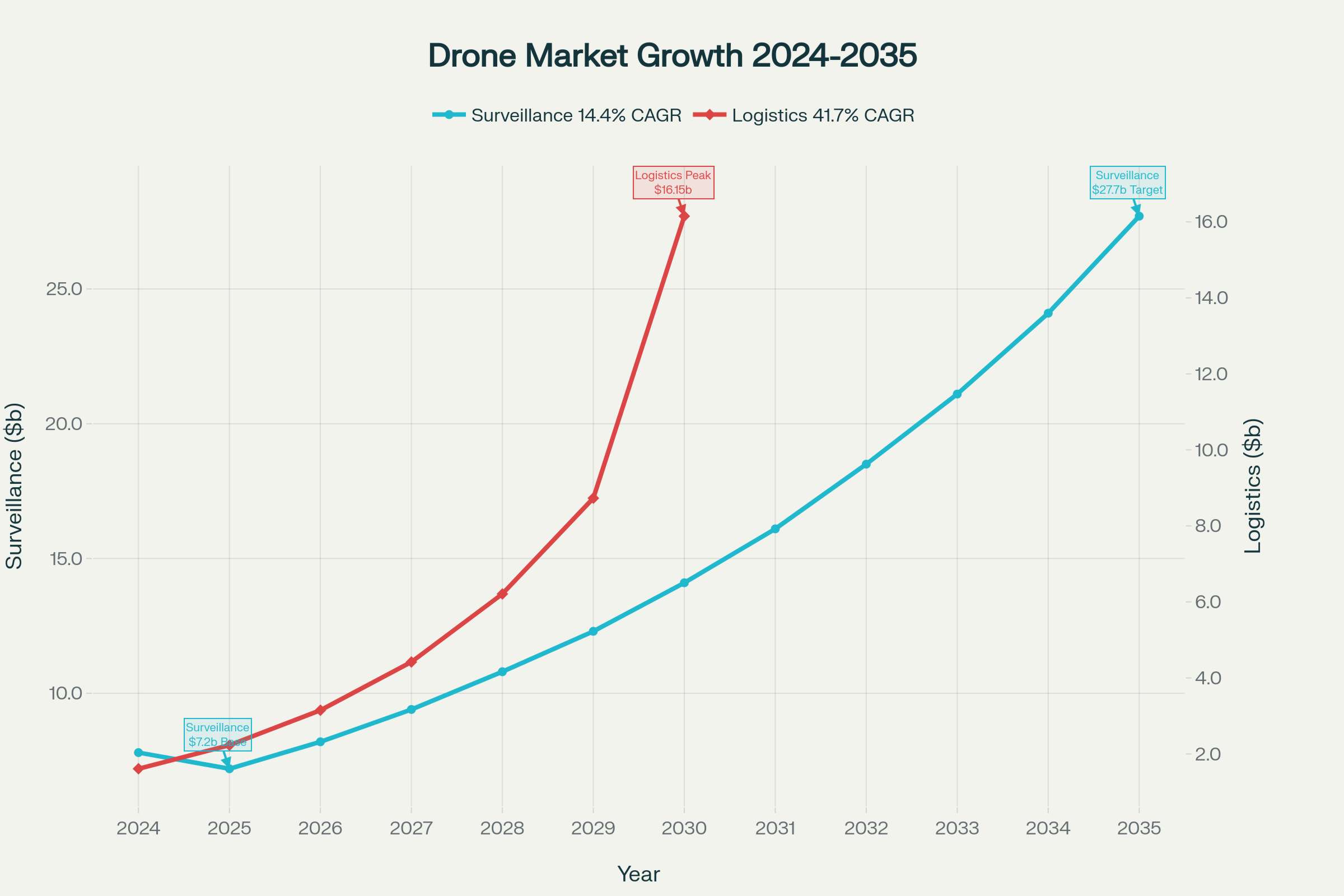
Drone Surveillance Market Growth in Logistics: 2024-2035
Modern cargo theft has evolved far beyond opportunistic pilferage into sophisticated criminal enterprises that exploit digital vulnerabilities alongside physical security gaps. Strategic theft now represents 18% of all cargo incidents in the United States, employing deception, fraud, and artificial intelligence for document forgery and system penetration. Criminal networks demonstrate deep understanding of supply chain operations, targeting high-value commodities including food and beverages (22% of thefts), agricultural goods (10%), electronics (9%), and pharmaceuticals during vulnerable transit periods.
The geographic concentration of criminal activity reveals systematic targeting strategies. California experienced a 33% increase in cargo thefts, while Texas incidents jumped 39%, with these states alongside Illinois accounting for nearly half of all U.S. cases. This concentration around major logistics hubs, distribution centers, and transportation corridors demonstrates criminals' strategic focus on high-density cargo movements where detection risks are minimized and escape opportunities maximized.
The financial impact extends beyond direct theft losses to encompass supply chain disruptions, insurance premium increases, and operational security investments. Rail cargo theft alone increased 89% in 2024, with experts estimating over 600 monthly incidents nationwide. The total economic burden reaches $30-35 billion annually when considering downstream effects on inventory replacement, delivery delays, customer satisfaction impacts, and enhanced security protocol implementation costs.
Criminal networks increasingly leverage technology platforms to identify targets and coordinate operations. Load boards and freight management systems provide real-time intelligence about cargo types, values, and movement schedules, enabling criminals to select high-value targets while avoiding enhanced security routes. Cyber-enabled tactics include phishing attacks targeting dispatch systems, identity fraud for fictitious carrier pickups, and social engineering schemes that exploit supply chain complexity.
The emergence of "theft by deception" represents a fundamental shift in criminal methodology. Fraudulent carriers pose as legitimate transportation providers to arrange pickups using falsified documentation and hacked communications. These schemes exploit the increasing reliance on digital freight coordination and the normalization of working with unknown carriers due to capacity constraints and cost pressures within the logistics industry.
Insider collusion compounds external threats, with criminal networks recruiting warehouse employees, security personnel, and transportation workers to provide operational intelligence and access. This multi-vector approach combines physical and cyber capabilities to bypass traditional security measures designed for external threats only.
Conventional surveillance systems struggle to provide comprehensive coverage across expansive logistics facilities that often span multiple acres with complex layouts including loading docks, storage areas, parking zones, and administrative sections. Fixed camera installations create systematic blind spots where criminals can operate undetected, while perimeter fencing and access controls fail to address sophisticated entry methods including drone reconnaissance, underground approaches, and coordinated multi-point breaches.
The scale challenge becomes particularly acute for outdoor storage areas and rail yards where assets are distributed across vast spaces with varying elevations and obstructions that limit traditional camera effectiveness. Night operations compound these challenges, as thermal imaging capabilities are typically limited to specific zones rather than comprehensive facility coverage, leaving criminals free to exploit temporal and spatial security gaps.
Manual security patrols, while necessary, cannot provide continuous coverage and are vulnerable to predictable routing patterns that experienced criminal networks can observe and circumvent. Guard staffing costs escalate significantly when attempting to provide adequate coverage for large facilities, while human factors including fatigue, distraction, and response time delays limit effectiveness against coordinated criminal operations.
Traditional incident investigation relies heavily on post-event video review, consuming 3-12 hours per incident while producing incomplete evidence trails that often fail to identify perpetrators or recovery stolen assets. Security personnel must manually search through hours of footage across multiple camera feeds to reconstruct incident timelines, a process that delays law enforcement notification and reduces recovery prospects.
The disconnected nature of conventional surveillance systems prevents correlation between video evidence and operational data, making it nearly impossible to identify exactly when and how inventory discrepancies occurred. This limitation particularly impacts warehouse shrinkage investigations where theft may occur over extended periods through systematic pilferage that remains undetected until quarterly inventory audits reveal significant losses.
Legacy systems also struggle with multi-location coordination, preventing security teams from identifying patterns across distributed logistics networks where criminal organizations may target multiple facilities using similar methodologies. This fragmentation allows criminal networks to refine their approaches based on successful operations while security teams remain unaware of broader threat patterns.
TRASSIR transforms logistics security through its integrated platform approach that synchronizes every operational event with corresponding video evidence, creating a unified control system that bridges physical security and operational intelligence. Unlike traditional systems that operate in isolation, TRASSIR's architecture correlates warehouse management system data with real-time video analytics, enabling instant investigation capabilities and comprehensive audit trails for compliance requirements.
The platform's 99% compatibility with existing camera infrastructure eliminates costly hardware replacements while enabling advanced AI capabilities through software upgrades. This universal compatibility allows logistics facilities to implement intelligent surveillance without disrupting current operations or requiring complete security system replacement, providing immediate return on investment through enhanced capabilities rather than capital expenditure.
TRASSIR's event-driven methodology represents the fundamental difference from conventional surveillance approaches. Every warehouse transaction, from receiving to shipping, automatically generates corresponding video evidence that can be instantly retrieved through operational parameters rather than time-based searches. This synchronization enables investigation teams to locate specific incidents within minutes instead of spending hours manually reviewing footage.

argo Theft Crisis & TRASSIR Security Solutions Impact
TRASSIR ActiveStock revolutionizes warehouse investigation capabilities by synchronizing video footage with operational events in real-time through robust API integration with existing warehouse management systems. This groundbreaking capability categorizes video content by warehouse scenarios, enabling instant searches by product, employee, document, or operational event rather than traditional time-based reviews.
The system maintains synchronized offline and online modes, ensuring continuous operation even during network interruptions that could otherwise create security vulnerabilities. Advanced search capabilities allow security teams to quickly identify patterns across multiple events, enabling proactive threat identification and operational optimization based on comprehensive data analysis.
The Arabesque Romania implementation across 21 warehouses achieved 30% reduction in security costs through automated investigation processes that eliminated the need for extensive manual review resources. Investigation teams can now correlate inventory discrepancies with specific video evidence instantly, dramatically improving theft detection and prevention capabilities while reducing labor requirements for security operations.
TRASSIR Neuro Detector addresses one of the most significant challenges in warehouse surveillance by achieving 95%+ accuracy in distinguishing between authorized personnel, vehicles, and genuine security threats. Traditional motion detection systems generate overwhelming numbers of false alarms from environmental factors, equipment movement, and routine operations, desensitizing security teams and wasting valuable response resources.
The neural network technology recognizes humans, vehicles, and bicycles with exceptional precision, virtually eliminating false positives that plague conventional systems. This accuracy improvement allows warehouses to implement automated alert systems without overwhelming security teams with irrelevant notifications, ensuring that genuine threats receive immediate attention while maintaining operational efficiency.
Neuro Detector supports distributed processing architectures, enabling warehouses to balance computational loads across their infrastructure while providing 24/7 autonomous monitoring capabilities. The system reduces staffing requirements while maintaining comprehensive coverage of critical areas, delivering significant cost savings without compromising security effectiveness.
TRASSIR Face Recognition delivers 99.8% accuracy in personnel identification while incorporating advanced anti-spoofing technology that prevents unauthorized access through photographs, video playback, or 3D mask attempts. This military-grade security capability ensures that sensitive warehouse areas remain accessible only to authorized personnel while maintaining comprehensive access logs for compliance auditing.
Advanced attribute-based search capabilities enable security teams to locate individuals based on age, gender, accessories, or other distinguishing characteristics when investigating incidents or tracking specific personnel movements. Database synchronization ensures real-time updates across all facility access points, maintaining consistent security protocols throughout complex warehouse environments with multiple entry and exit points.
The technology streamlines visitor management processes while providing valuable operational insights that help facility managers optimize staffing patterns and identify potential security vulnerabilities. Automated personnel tracking capabilities create comprehensive behavioral baselines that enable detection of unusual activity patterns that may indicate security threats or operational inefficiencies.
Modern drone surveillance systems integrate seamlessly with video management platforms to provide coordinated aerial monitoring that eliminates blind spots inherent in fixed camera installations. Autonomous drones can execute pre-planned patrol routes while responding to real-time alert triggers from ground-based sensors, creating a comprehensive security net that adapts to evolving threats and operational requirements.
The integration of autonomous drones with VMS platforms allows operators to view live drone feeds directly within centralized monitoring systems, enabling instantaneous situational assessments and faster response to alarm triggers. This unified approach ensures quicker response times, enhanced visibility, and greater return on investment by maximizing the utility of existing security infrastructure while adding aerial intelligence capabilities.
Fleet management systems enable multiple drones to operate simultaneously across large logistics facilities, with automated coordination that prevents airspace conflicts while ensuring comprehensive coverage. Advanced battery management and automated charging capabilities support continuous operations without manual intervention, providing 24/7 aerial surveillance capabilities that complement ground-based security measures.
Drone-mounted AI systems process video data in real-time to identify potential threats, unauthorized personnel, and suspicious activities across expansive logistics facilities. Machine learning algorithms enable automatic detection of humans, vehicles, and objects of interest while filtering out false alarms from environmental factors, wildlife, and routine operations that could otherwise overwhelm security teams.
Advanced thermal imaging capabilities extend surveillance effectiveness to nighttime operations and adverse weather conditions where traditional cameras struggle to maintain adequate visibility. AI-powered analysis of thermal signatures can distinguish between humans, vehicles, and equipment while detecting temperature anomalies that might indicate fire risks or equipment malfunctions that require immediate attention.
Object tracking algorithms maintain continuous surveillance of identified targets across multiple camera feeds and drone platforms, ensuring that suspicious activities remain under observation even when individuals move between coverage zones. This comprehensive tracking capability prevents criminals from exploiting coverage gaps while providing continuous intelligence for security team response coordination.
Tenaga Nasional Berhad's (TNB) implementation in Malaysia demonstrates the transformative impact of drone-integrated warehouse management, reducing inventory verification time from three months to 24 hours through autonomous drone dock systems. The 43-hectare facility processes approximately 2,000 images daily through AI algorithms that achieve 90% overall detection accuracy for electrical equipment including transformers (95% accuracy) and cable bundles (80-85% accuracy).
The system's ability to provide daily asset verification creates near real-time awareness of warehouse contents, including quantities, classifications, and precise locations of critical components. TNB engineers now receive updated information about available storage areas every other day, allowing efficient planning of equipment deliveries and placements that optimize space utilization and operational workflow.
The implementation delivered immediate operational improvements including drastically reduced verification times, enhanced inventory visibility, optimized space utilization, and data-driven decision making capabilities. Following the initial success, TNB is expanding autonomous drone technology deployment to additional facilities for comprehensive security monitoring and exploring potential applications in electrical substation inspections.
TRASSIR implementations consistently deliver 30% reduction in theft losses through intelligent video analytics that identify suspicious behavior patterns before losses occur. The Saudi Logistics Services deployment demonstrates how comprehensive video intelligence transforms large-scale warehouse operations by enabling automated vehicle tracking and optimized clearance processes that maintain security protocols while improving operational efficiency.
Real-time monitoring capabilities provide faster turnaround times for legitimate operations while maintaining strict security oversight that prevents unauthorized access or asset removal. The integration with existing operational systems ensures seamless workflow integration without disrupting established procedures that support day-to-day logistics operations.
Advanced search capabilities enable security teams to quickly locate and analyze security events, eliminating the need for extensive manual investigation resources that consume significant time and labor. Most warehouse implementations achieve return on investment within 12 months, with some facilities reporting payback periods as short as 4-6 months due to reduced theft losses, decreased investigation time, and improved operational efficiency.
Event-driven video intelligence reduces investigation time by 90%, transforming processes that previously required 3-12 hours into minute-level analyses that provide comprehensive incident reconstruction. This dramatic improvement enables immediate law enforcement notification and evidence preservation that significantly increases recovery prospects and prosecution success rates.
The correlation between operational data and video evidence enables instant identification of exactly when and where inventory discrepancies occurred, supporting both loss prevention and process improvement initiatives. Security teams can identify patterns across multiple incidents to develop proactive countermeasures rather than merely responding to completed thefts after losses have occurred.
Automated alert generation ensures that security personnel receive immediate notification of potential threats without requiring continuous monitoring of multiple video feeds. This intelligent filtering reduces staffing requirements while ensuring that genuine security incidents receive appropriate priority and response resources.
The Arabesque Romania deployment across 21 warehouses achieved 30% reduction in security costs through automated access control and streamlined investigation processes. Integrated security platforms eliminate redundant systems and personnel requirements while providing enhanced capabilities that support both security and operational objectives.
Comprehensive facility coverage through drone-integrated surveillance reduces the need for extensive human patrols while providing superior threat detection capabilities. Automated systems operate continuously without fatigue or distraction, ensuring consistent security coverage that adapts to evolving threat patterns and operational requirements.
Predictive maintenance capabilities identify equipment issues before failures occur, reducing downtime and maintenance costs while ensuring operational continuity. The integration of physical security with operational monitoring creates comprehensive facility management capabilities that support multiple business objectives through unified technology platforms.
High-velocity e-commerce fulfillment centers require security solutions that operate seamlessly alongside rapid order processing and shipping operations. TRASSIR's integration capabilities support real-time correlation between order fulfillment data and video evidence, enabling instant investigation of discrepancies while maintaining operational throughput requirements.
Advanced people counting and flow analysis optimize staffing patterns and facility layouts while identifying potential security vulnerabilities created by operational bottlenecks or access pattern changes. Automated vehicle tracking ensures that loading dock operations maintain security protocols while processing high volumes of inbound and outbound shipments efficiently.
Face recognition technology streamlines employee access while maintaining detailed logs of personnel movements that support both security investigations and operational optimization. The ability to correlate individual employee activities with specific operational events enables identification of both security threats and productivity improvement opportunities.
Manufacturing facilities with integrated logistics operations require security solutions that protect both intellectual property and physical assets while supporting complex operational workflows. TRASSIR's industrial-grade solutions provide comprehensive monitoring of production areas, raw material storage, and finished goods warehouses through unified platforms that correlate security and operational data.
Thermal imaging capabilities monitor equipment temperatures and identify potential fire hazards before they threaten facility operations or personnel safety. Advanced analytics detect unauthorized access to sensitive production areas while ensuring that legitimate personnel movements support efficient manufacturing operations.
Integration with industrial IoT systems enables comprehensive facility monitoring that addresses security, safety, and operational efficiency through unified data platforms. This comprehensive approach reduces technology complexity while providing enhanced capabilities for complex industrial environments.
Rail cargo theft increased 89% in 2024, making enhanced security measures essential for intermodal logistics operations. Drone surveillance addresses the unique challenges of rail yard security by providing comprehensive coverage across extensive outdoor facilities where traditional camera installations struggle with distance limitations and environmental factors.
Automated train monitoring capabilities detect unauthorized access to railcars while identifying suspicious activities around loading and unloading operations. Advanced analytics correlate cargo manifests with video evidence to identify discrepancies immediately rather than waiting for destination inventory checks that may occur days or weeks after theft incidents.
Perimeter monitoring across extensive rail facilities requires integrated ground and aerial surveillance capabilities that adapt to varying weather conditions and lighting scenarios. TRASSIR's comprehensive solutions provide the scalability and reliability necessary for effective rail facility protection.
TRASSIR's cloud-ready architecture supports scalable deployment across multiple logistics facilities while maintaining centralized management capabilities that enable coordinated security operations. Organizations can implement solutions incrementally, starting with high-priority facilities and expanding coverage based on demonstrated value and operational requirements.
API integration capabilities ensure compatibility with emerging logistics technologies including autonomous vehicles, robotic systems, and advanced warehouse management platforms. This flexibility enables logistics organizations to protect technology investments while adapting security capabilities to evolving operational requirements and threat landscapes.
Machine learning algorithms continuously improve detection accuracy by adapting to each facility's unique operational characteristics and threat profiles. This ongoing optimization ensures that security effectiveness improves over time rather than degrading due to changing operational patterns or criminal adaptation strategies.
Advanced analytics capabilities enable predictive threat identification by analyzing historical data patterns and correlating security incidents with operational factors. This proactive approach supports prevention-focused security strategies rather than reactive response protocols that only address threats after losses have occurred.
Integration with supply chain intelligence platforms provides awareness of broader threat patterns that may affect multiple facilities or logistics networks. This comprehensive threat picture enables coordinated defensive measures and informed risk management decisions across distributed operations.
Behavioral analysis algorithms establish baseline operational patterns that enable detection of subtle anomalies that may indicate developing security threats. Early threat identification supports intervention before criminal activities reach completion, minimizing losses while deterring future targeting attempts.
TRASSIR solutions support compliance with evolving data protection regulations through granular access controls, user permissions, and comprehensive audit trails that ensure video data handling meets regulatory requirements. Automated retention policies ensure that surveillance data management complies with industry standards and legal requirements without requiring manual intervention.
Integration with incident reporting systems streamlines compliance documentation while providing comprehensive evidence packages that support law enforcement investigations and insurance claim processing. This automated approach reduces administrative burden while ensuring complete documentation of security incidents.
Advanced encryption and cybersecurity features protect surveillance data from unauthorized access while ensuring system integrity against cyber threats that increasingly target logistics infrastructure. Multi-layered security architecture prevents compromise of surveillance systems that could otherwise create security vulnerabilities.
Successful TRASSIR implementation follows a systematic approach beginning with comprehensive security assessments that identify specific threats, operational requirements, and integration needs. Initial pilot deployments enable organizations to evaluate capabilities and refine configurations before full-scale implementation across multiple facilities.
Critical area prioritization ensures that highest-risk zones receive enhanced security coverage first while supporting gradual expansion based on demonstrated value and available resources. This approach minimizes operational disruption while delivering immediate security improvements in areas with greatest exposure to theft and security threats.
Training programs ensure that security personnel and facility managers understand system capabilities and can leverage advanced features effectively. Ongoing support services provide technical assistance and system optimization that maintains peak performance and adapts to evolving security requirements.
Return on investment calculations must consider both direct security benefits and operational efficiency improvements that result from integrated intelligence platforms. Theft reduction, investigation efficiency, and operational optimization typically justify implementation costs within 6-12 months for most logistics facilities.
Total cost of ownership analysis should include reduced staffing requirements, decreased investigation time, improved insurance terms, and operational efficiency gains that extend beyond traditional security benefits. Comprehensive business case development supports executive approval and funding allocation for security technology investments.
Scalability considerations ensure that initial investments support future expansion and technology evolution rather than requiring complete system replacement as requirements change. Technology roadmap alignment supports long-term value creation while protecting capital investments in security infrastructure.
Logistics executives must evaluate security technology investments within the context of comprehensive risk management strategies that address both immediate threats and long-term operational resilience. TRASSIR's proven track record across 500,000 global deployments provides confidence in technology reliability and vendor stability for critical security infrastructure investments.
Integration capabilities should receive priority consideration to ensure that security investments enhance rather than complicate existing operational systems and workflows. The ability to correlate security and operational data creates value beyond traditional surveillance applications while supporting comprehensive facility management objectives.
Vendor selection criteria must emphasize ongoing support capabilities, system scalability, and technology evolution potential rather than simply initial acquisition costs. Long-term partnerships with technology providers ensure continued value creation and adaptation to evolving security threats and operational requirements.
Comprehensive facility assessments should precede technology selection to ensure that chosen solutions address specific threat patterns and operational requirements rather than generic security needs. Site-specific customization optimizes system effectiveness while ensuring seamless integration with existing infrastructure and procedures.
Stakeholder engagement across security, operations, IT, and executive teams ensures that implementation decisions reflect comprehensive organizational requirements and priorities. Cross-functional collaboration supports successful deployment while maximizing system utilization and return on investment.
Training and change management programs prepare personnel for enhanced capabilities while ensuring that organizational processes adapt to leverage new intelligence and response capabilities. Effective change management prevents under-utilization of advanced features while supporting continuous improvement in security operations.
The convergence of drone technology with intelligent video management represents a paradigm shift in logistics security that addresses both the scale and sophistication of modern threats. TRASSIR's comprehensive platform demonstrates that integrated security solutions can deliver measurable improvements in theft prevention, investigation efficiency, and operational optimization while supporting regulatory compliance and scalability requirements.
Organizations implementing TRASSIR's drone-integrated security solutions gain competitive advantages through enhanced operational visibility, reduced loss exposure, and improved compliance capabilities that extend beyond traditional security benefits. The proven track record across diverse logistics environments confirms that intelligent surveillance represents a strategic investment in operational resilience rather than simply a security upgrade.
The logistics industry cannot afford to maintain reactive security approaches in the face of escalating threats and increasing operational complexity. TRASSIR's proven solutions provide the intelligence capabilities necessary to protect assets while optimizing operations, delivering quantifiable value that justifies investment and supports long-term competitive advantage in an increasingly challenging operational environment.
Contact TRASSIR's logistics specialists to schedule a comprehensive facility assessment and discover how intelligent video surveillance can transform your warehouse security posture. Experience the difference between passive surveillance and active operational intelligence through a customized demonstration of TRASSIR's warehouse-specific solutions designed for the logistics industry's unique requirements and challenges.
Articles
All articles
The Complete Guide to Retail Crowd Density Monitoring Using Video Analytics
The Complete Guide to Retail Crowd Density Monitoring Using Video Analytics

The Ultimate Guide to Occupancy Tracking Technology: Systems, Sensors, and Strategy
The Ultimate Guide to Occupancy Tracking Technology: Systems, Sensors, and Strategy
Maximizing Retail Performance: The Ultimate Guide to Heat Mapping Technology
Maximizing Retail Performance: The Ultimate Guide to Heat Mapping Technology

The Complete Guide to Deploying AI Video Analytics in Retail and Enterprise
The Complete Guide to Deploying AI Video Analytics in Retail and Enterprise

How to Design a Scalable Video Surveillance System for Multi-Site Retail
How to Design a Scalable Video Surveillance System for Multi-Site Retail

Upgrading Legacy CCTV: How to Integrate AI Without a Rip-and-Replace
Upgrading Legacy CCTV: How to Integrate AI Without a Rip-and-Replace

Upgrading Legacy CCTV: The Complete Guide to AI Security Camera Integration
Upgrading Legacy CCTV: The Complete Guide to AI Security Camera Integration
The Evolution of Video Analytics: How AI Transforms Security and Operations
The Evolution of Video Analytics: How AI Transforms Security and Operations

How AI Video Surveillance Solves Security Staffing Shortages and Reduces Costs
How AI Video Surveillance Solves Security Staffing Shortages and Reduces Costs

Maximizing Security System ROI: The Financial Case for Smart Surveillance
Maximizing Security System ROI: The Financial Case for Smart Surveillance

How to Calculate the ROI of a Business Security System
How to Calculate the ROI of a Business Security System
Master Multi-Brand CCTV Management: The Ultimate Guide to Brand-Agnostic Surveillance
Master Multi-Brand CCTV Management: The Ultimate Guide to Brand-Agnostic Surveillance

Strategic Guide to Retail Video Surveillance Migration: Upgrading Legacy Systems
Strategic Guide to Retail Video Surveillance Migration: Upgrading Legacy Systems

How to Reduce Commercial Security Costs Without Compromising Protection
How to Reduce Commercial Security Costs Without Compromising Protection

How to Reduce Retail Operational Costs With Video Analytics
How to Reduce Retail Operational Costs With Video Analytics

Security Staffing Optimization: The Complete 2026 Guide
Security Staffing Optimization: The Complete 2026 Guide

AI Retail Theft Prevention: How Smart Cameras Stop Shrinkage
AI Retail Theft Prevention: How Smart Cameras Stop Shrinkage

Modern Shopping Center Security Systems: The Complete Guide
Modern Shopping Center Security Systems: The Complete Guide

Video Management Systems Explained: Features, Benefits, and How to Choose the Right VMS
Video Management Systems Explained: Features, Benefits, and How to Choose the Right VMS

The Reality of the Single Pane of Glass: Achieving Unified IT Visibility
The Reality of the Single Pane of Glass: Achieving Unified IT Visibility
Try TRASSIR For Your Business
Learn more about how TRASSIR analytic modules work! Demo mode is an opportunity to see for yourself how the system works, and also check the interface and test all the functions.Success!
We will contact you as soon as possible