




Video Analytics for Inventory Management: Streamlining Operations with TRASSIR's Intelligent Solutions
The modern logistics landscape faces unprecedented challenges as warehouse theft costs the industry over $35 billion annually, while cargo theft incidents surge 33% year-over-year. Traditional security systems capture footage but fail to provide the real-time intelligence needed to prevent losses and streamline investigations. Video analytics for inventory management represents a paradigm shift from passive recording to active operational control, offering logistics professionals a comprehensive solution to optimize warehouse operations while maintaining security integrity.
TRASSIR, the global leader in intelligent video management with over 500,000 deployed projects across 42+ countries, transforms warehouse security through event-driven video intelligence. This technology integration addresses critical operational challenges faced by business owners, security directors, IT directors, developers, technical specialists, and system integrators in the logistics sector. Advanced video analytics systems reduce theft by 30%, cut investigation time from hours to minutes, and deliver measurable ROI within 4-12 months of implementation.
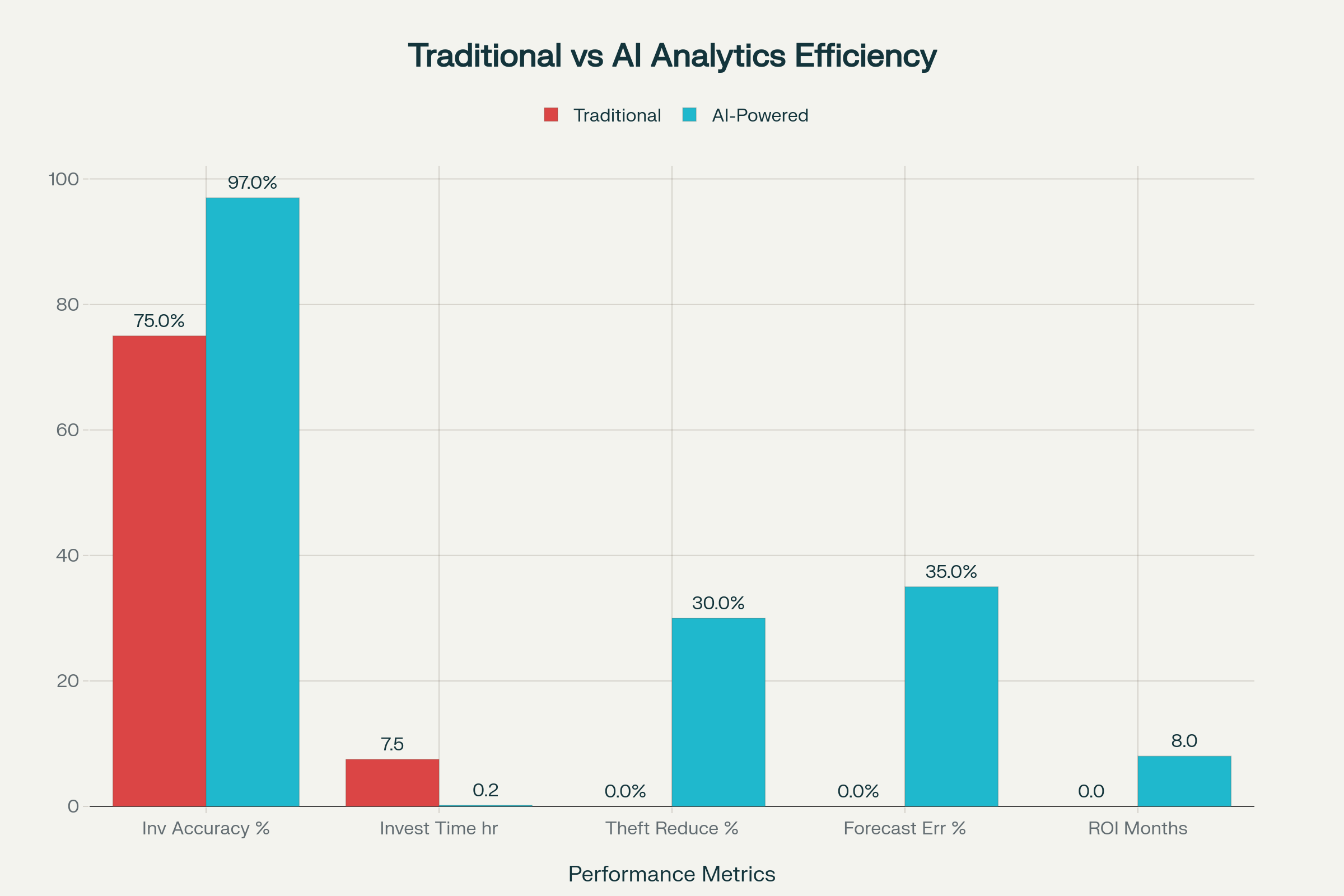
Traditional vs AI-Powered Video Analytics: Performance Comparison in Warehouse Inventory Management
Warehouse operations today manage not just more inventory, but increasingly complex inventory including serialized parts, lot-controlled items, kitted assemblies, high-value components, and temperature-sensitive stock. Inventory accuracy remains the single most frequently cited challenge among warehouse professionals, with 62.3% of survey respondents ranking it as their top operational hurdle. Traditional inventory control systems achieve only 85-90% accuracy rates, creating significant operational and financial consequences that ripple throughout the entire supply chain.
The root causes of inventory discrepancies stem from multiple sources within warehouse operations. Cycle counting inefficiencies plague many warehouses, where periodic manual counts frequently reveal discrepancies between system records and actual stock levels. These disparities arise from picking and packing errors during order fulfillment, mistakes during receiving processes, misplaced inventory throughout the facility, and system lags caused by delays in data entry or updates within warehouse management systems.
Phantom inventory creates situations where systems show available stock that doesn't actually exist, leading to stockouts and lost sales. Conversely, overstocking ties up capital and warehouse space while increasing carrying costs. Customer satisfaction suffers when orders cannot be fulfilled due to inventory discrepancies, potentially damaging long-term relationships and brand reputation.
Cargo theft has reached crisis levels, with 2,217 reported incidents in 2024 representing a 49% increase from 2023. The average cargo theft incident now costs businesses $202,000, while organized crime groups increasingly target high-value commodities stored in distribution centers. Internal theft compounds these external threats, with warehouse shrinkage accounting for 36.5% of all retail losses.
Traditional security systems fail to identify suspicious employee behavior patterns, as manual investigation processes consume 3-12 hours per incident, creating costly delays and incomplete evidence trails. According to industry statistics, most thefts in warehouses are carried out by staff themselves, with employee theft accounting for 22% of shrinkage in retail sales, and 18% of that attributable to warehouse thefts specifically.
The distribution of cargo theft by location reveals significant vulnerabilities across the logistics network. Company yards and premises account for 29% of theft incidents, while unsecured parking areas contribute 21%, and warehouse/distribution centers represent 18% of total theft occurrences.
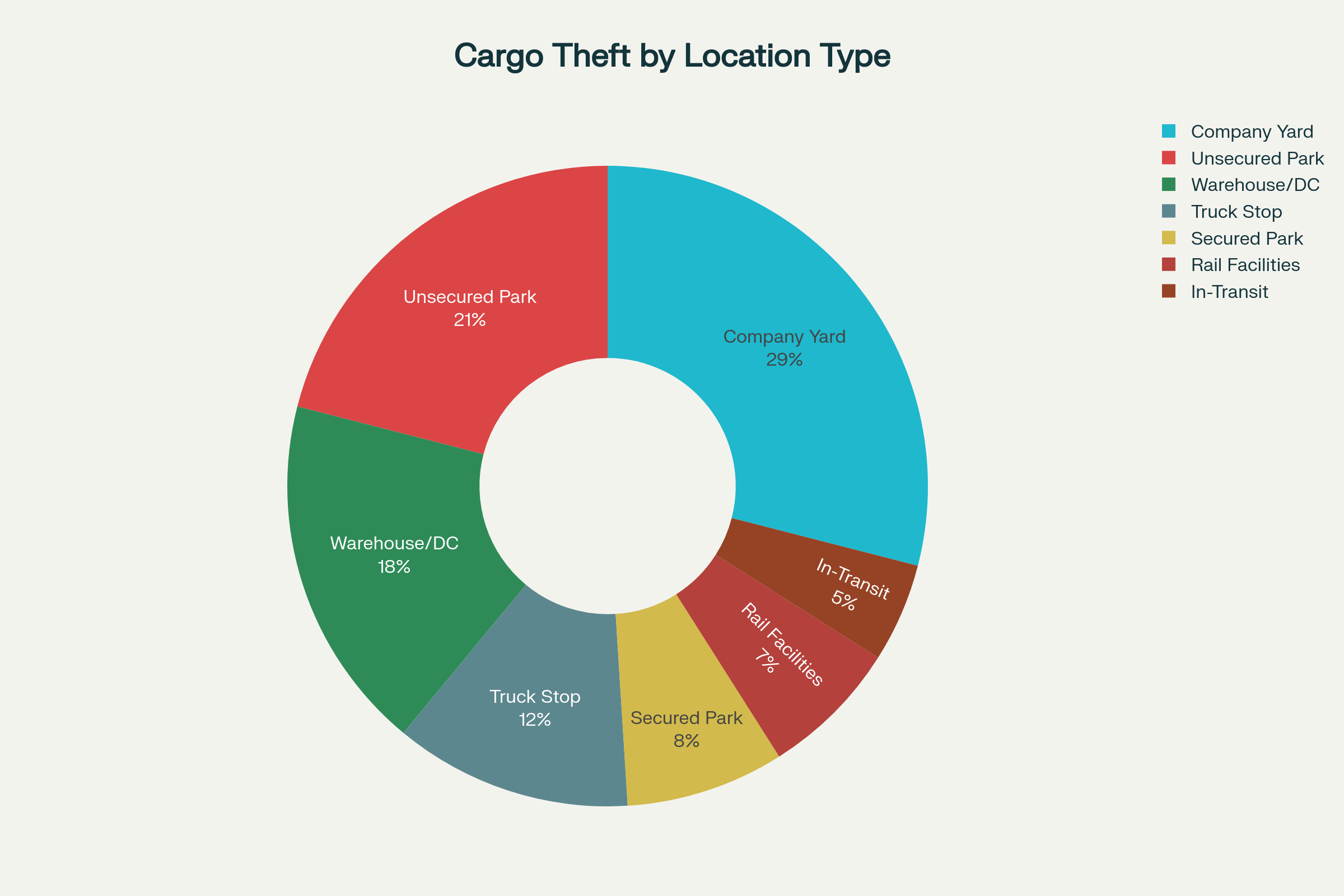
Cargo Theft Distribution by Location Type (2023 Data)
Labor shortages represent one of the most acute warehouse challenges, with 78% of facilities reporting significant difficulties in hiring and retaining qualified staff. Recent data reveals a staggering shortage of 430,000 warehouse positions across the United States in 2024. Turnover rates for warehouse staff average 36% annually, creating a constant cycle of recruitment, training, and onboarding that strains resources and disrupts operational efficiency.
High turnover results in productivity losses as new and less experienced workers are more prone to making inventory and picking errors, ultimately increasing operational costs by 15-25% above industry averages. Training new employees in complex warehouse environments requires substantial time and financial investment, as modern warehouses often handle thousands of SKUs across multiple product categories.
Disconnected systems across warehouse operations create data silos that significantly impair operational visibility and decision-making capabilities. These silos can reduce real-time operational visibility by up to 40%, preventing warehouse managers from accessing comprehensive information needed to optimize performance and quickly identify bottlenecks.
Legacy surveillance systems operate in isolation from warehouse management systems (WMS), creating dangerous operational blind spots. Security teams cannot correlate video footage with inventory movements, making it nearly impossible to investigate discrepancies efficiently. The disconnected nature of traditional systems forces security personnel to manually search through hours of footage to understand what happened during specific operational events.
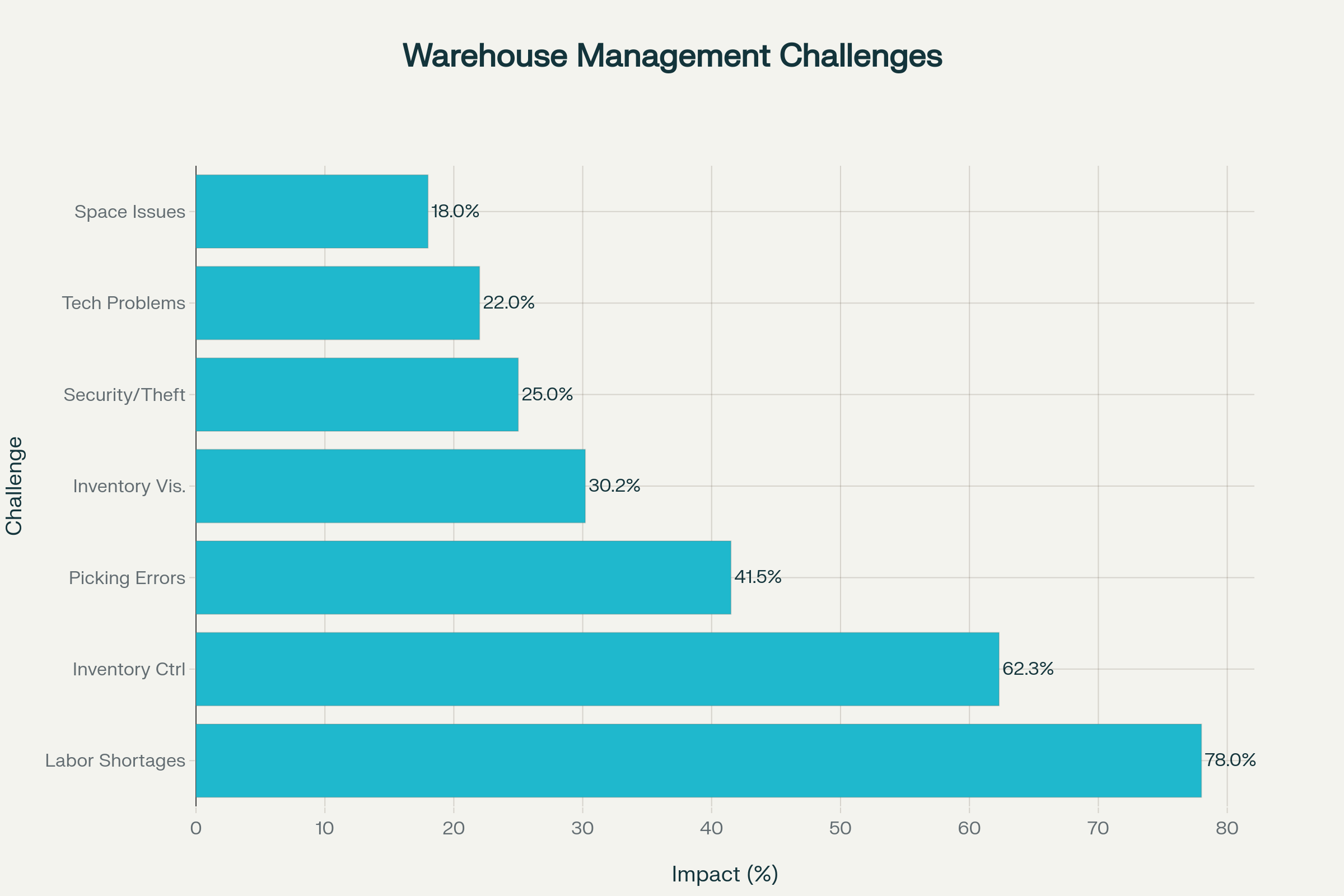
Top Warehouse Management Challenges: Percentage of Operations Affected
TRASSIR ActiveStock revolutionizes warehouse investigation capabilities by synchronizing video footage with operational events in real-time. This groundbreaking system integrates directly with existing WMS platforms through robust APIs, creating seamless information flow between warehouse operations and security systems. The system categorizes video content by warehouse scenarios, enabling instant searches by product, employee, document, or operational event.
Investigation teams can locate specific incidents within minutes instead of spending 3-12 hours manually reviewing footage. The Arabesque Romania implementation across 21 warehouses achieved 30% reduction in security costs through this automated approach. The system maintains synchronized offline and online modes, ensuring continuous operation even during network interruptions.
ActiveStock allows quick and convenient searching by warehouse events including order numbers and documents, product names, article numbers, cell numbers, pallets, or other identifiers. The system was developed taking into account the long-term experience of retail specialists, which guarantees the reliability and effectiveness of its work. Over 2,000 clients have implemented TRASSIR video analytics in their projects, with 95% of users transitioning to permanent use after the trial period.
TRASSIR Neuro Detector eliminates the false alarm problem that plagues traditional motion detection systems. Using advanced neural networks, the system achieves 95%+ accuracy in distinguishing between authorized personnel, vehicles, and potential security threats. The technology recognizes humans, vehicles, and bicycles with exceptional precision, virtually eliminating false positives that waste security resources.
This accuracy improvement allows warehouses to implement automated alert systems without overwhelming security teams with irrelevant notifications. Neuro Detector supports distributed processing architectures, enabling warehouses to balance computational loads across their infrastructure. The system provides 24/7 autonomous monitoring capabilities, reducing staffing requirements while maintaining comprehensive coverage of critical areas.
The neural network module allows efficient territory protection by generating alert events, forming reports, sending notifications to the alarm monitor in the TRASSIR client, email, SMS messages, and working with the Telegram bot. When suspicious behaviors are detected, Neuro Detector can automatically trigger lockdown procedures, alert security personnel, and begin recording high-resolution video for forensic analysis.
TRASSIR Face Recognition delivers 99.8% accuracy in personnel identification, providing military-grade security for sensitive warehouse areas. The system includes live face verification with anti-spoofing technology, preventing unauthorized access through photographs or video playback. Advanced attribute-based search capabilities enable security teams to locate individuals based on age, gender, accessories, or other distinguishing characteristics.
Database synchronization ensures real-time updates across all facility access points, maintaining consistent security protocols throughout complex warehouse environments. The technology streamlines visitor management processes while maintaining comprehensive access logs for compliance auditing. Automated personnel tracking capabilities provide valuable operational insights, helping facility managers optimize staffing patterns and identify security vulnerabilities.
The system supports both single-server and multi-server TRASSIR systems with unified database functionality. Face Recognition includes Face SDK for comparing faces and Face Search for searching faces in the database, with licensing provided per channel regardless of the number of faces in the database.
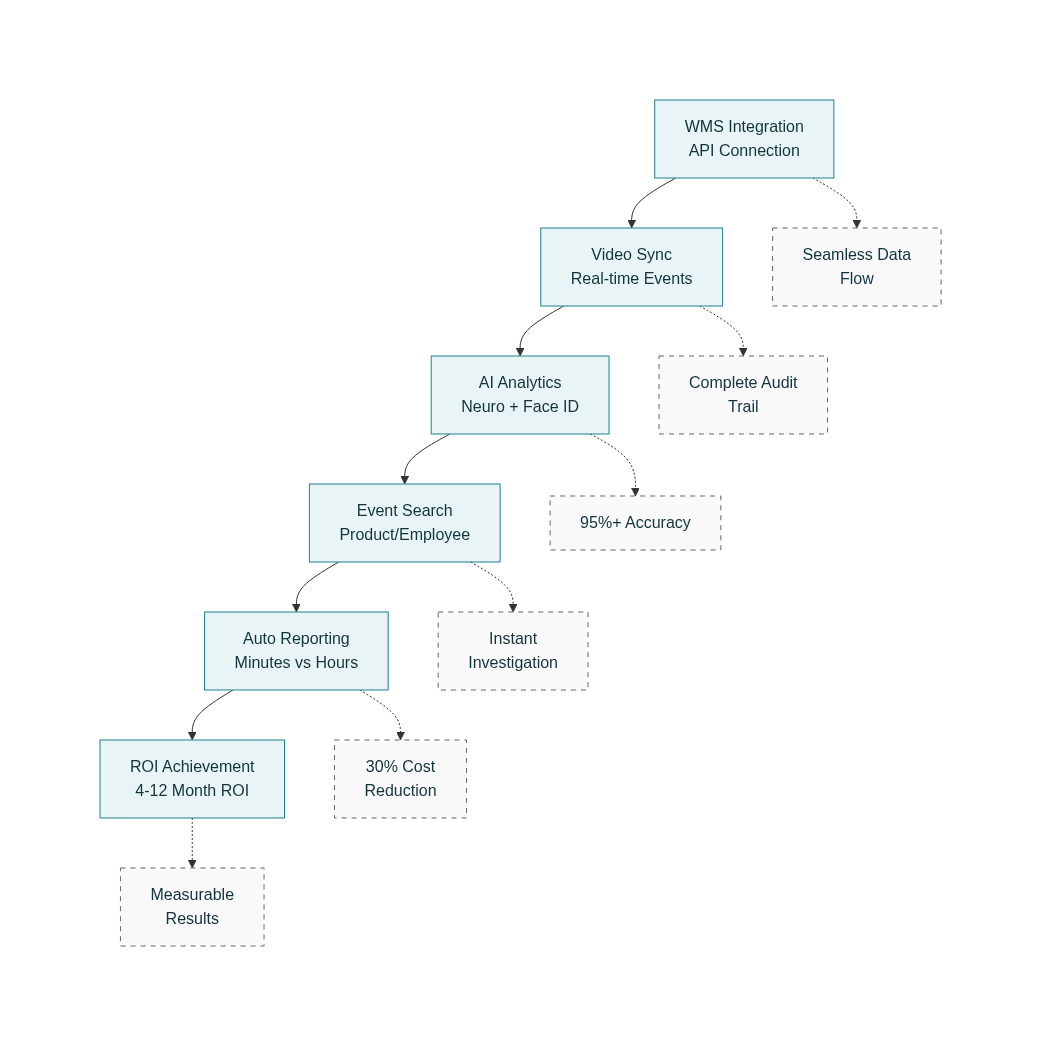
TRASSIR ActiveStock Integration Workflow and Key Components
TRASSIR implementations consistently deliver quantifiable improvements in security effectiveness and operational efficiency. Most warehouse implementations achieve return on investment within 12 months, with some facilities reporting payback periods as short as 4-6 months. These rapid ROI achievements result from reduced theft losses, decreased investigation time, improved operational efficiency, and enhanced insurance claim processing capabilities.
The Saudi Logistics Services deployment demonstrates how comprehensive video intelligence transforms large-scale warehouse operations. The implementation enhanced operational efficiency through automated vehicle tracking and optimized clearance processes. Real-time monitoring capabilities enabled faster turnaround times while maintaining strict security protocols.
Warehouse operations implementing video analytics solutions report significant performance improvements. On average, 34% acceleration in loading and unloading operations is achieved, while 41% increase occurs in the number of processes completed on time. These improvements directly translate to enhanced customer satisfaction and competitive advantage in the logistics market.
Advanced warehouse automation systems deliver substantial cost benefits across multiple operational areas. Automated warehouses can cut operational costs by 20%, with inventory accuracy improvements reaching 99.5% compared to traditional manual systems achieving only 85-90% accuracy. Companies implementing AI-powered inventory management systems report 20-50% reduction in forecasting errors compared to traditional methods.
Video analytics solutions provide multiple cost-saving opportunities. Reducing staff administration and training costs, optimizing product handling and storage costs, minimizing inventory errors, and eliminating the risk of mishandling and product loss contribute to impressive ROI. Warehouse automation offers multiple new points for savings, with inventory turnover improvements reaching 8-10 times per year with AI-powered systems compared to 4-6 times per year with traditional systems.
The financial impact extends beyond immediate operational improvements. Organizations report 65% reductions in incident response times through automated correlation between physical and cyber events. False security alerts decrease by 40% due to AI-powered filtering and contextual analysis capabilities, while overall security operations costs decrease by 25% through centralized management and automated response workflows.
TRASSIR VMS platform provides 99% compatibility with existing camera infrastructure, eliminating costly hardware replacements while enabling advanced AI capabilities. This universal compatibility allows warehouses to upgrade their intelligence capabilities without disrupting current operations. The platform's neural network architecture processes video data in real-time, identifying patterns and anomalies that human observers would miss.
Machine learning algorithms continuously improve detection accuracy, adapting to each facility's unique operational characteristics and threat profiles. The system's ability to quickly locate and analyze security events eliminated the need for extensive manual investigation resources. Integration capabilities extend beyond security applications to encompass comprehensive operational optimization.
Smart warehouse technologies demonstrate remarkable scalability advantages. The global smart warehouse market is projected to grow from $29.81 billion in 2025 to $98.64 billion by 2034, at a strong CAGR of 14.22%. This growth reflects widespread recognition of video analytics' transformative potential in logistics operations.
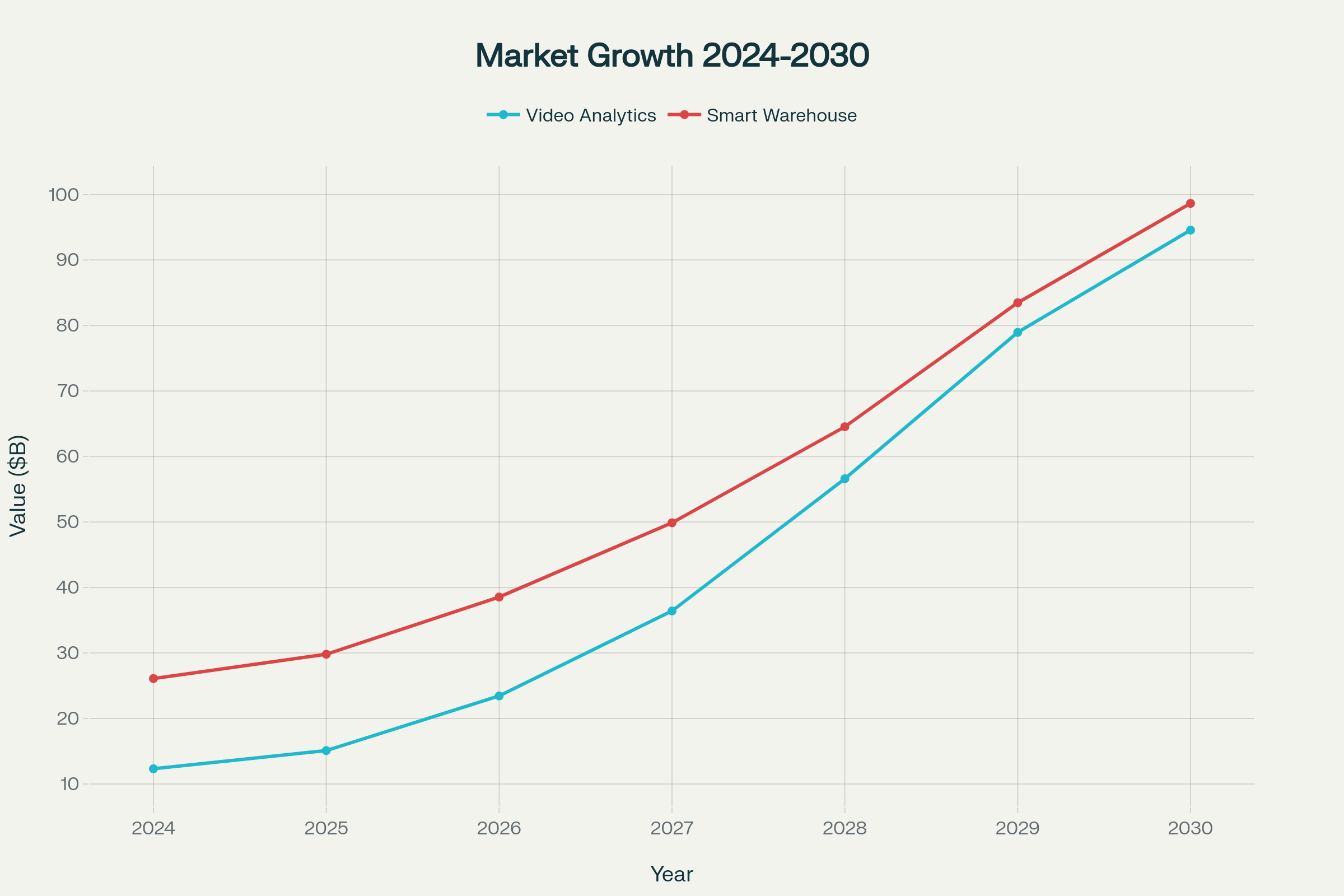
Video Analytics and Smart Warehouse Market Growth Projections (2024-2030)
Video analytics applications in retail distribution centers address multiple operational challenges simultaneously. Systems can analyze customer behavior, optimize store layouts, and reduce theft by identifying suspicious activities. This application not only enhances security but also contributes to improving customer experience and operational efficiency.
Implementation in retail environments requires careful consideration of privacy regulations and customer experience factors. Video analytics helps provide instant alerts that occur in various business areas to enhance situational awareness. The technology enables services that employees cannot perform as efficiently, such as unusual visual perception with high accuracy, vehicle location recognition, and auto-tracking.
Modern retail operations utilize video analytics to monitor traffic patterns, analyze customer flow, and optimize inventory placement. The integration of AI-enabled video analytics solutions contributes to market growth, with deployment of AI-enabled video content analysis solutions rapidly increasing globally. Government agencies actively select AI-based video systems to monitor track congestion and improve operational efficiency.
The transportation and logistics sector experiences unique benefits from video analytics implementation. The decrease of congestion, behavior analysis, increased safety measures, incident recording, and blind spot detection are just a few of the numerous advantages of video analytics for the transportation and logistics vertical. This comprehensive monitoring capability enhances both security and operational efficiency across the supply chain network.
Various capabilities of video analytics, including facial recognition, object tracking, unidentified object detection, cargo and train carriage recognition, and intelligent traffic monitoring, help logistics and transportation businesses prevent disasters and spot emerging threats. These systems can find robust usage across law enforcement, government, transportation, banking, and finance sectors.
Smart city initiatives drive significant adoption of video analytics in transportation infrastructure. Governments are investing heavily in infrastructure, incorporating advanced surveillance systems to enhance public safety and streamline urban management. Cities deploy intelligent traffic management systems that utilize video analytics to monitor traffic flow, reduce congestion, and improve emergency response times.
Manufacturing environments benefit from video analytics through enhanced safety monitoring, quality control, and operational efficiency improvements. AI-powered systems can analyze the flow of goods and vehicles, read the numbers of cars and railway cars, and record the arrival/departure time. Implementation of warehouse management systems alone cannot cope with such a number of tasks without video analytics support.
Integration with existing enterprise systems enables comprehensive operational optimization. Video analytics can help detect lost goods and improve accounting accuracy by automatically monitoring the movement of goods. In the event of disputes, warehouse owners can receive full reports on operations, including video recordings, time-stamped photos, cargo names, batch numbers, and names of officials responsible for receiving/shipping.
The convergence of physical and cyber security creates new opportunities for comprehensive threat protection in manufacturing environments. TRASSIR's integrated approach addresses both traditional security concerns and emerging cyber-physical threats that target warehouse operations through connected systems. This dual-purpose capability transforms surveillance investments from cost centers into strategic operational assets.
Future warehouse operations will depend increasingly on predictive analytics and automated response capabilities. TRASSIR's machine learning foundation provides the technological infrastructure necessary to adapt to evolving security challenges and operational requirements. Smart surveillance systems enable data-driven decision making by providing comprehensive operational metrics alongside security intelligence.
The integration of artificial intelligence into video analytics continues advancing rapidly. AI will further refine operations through predictive analytics, enabling warehouses to anticipate demand spikes, streamline inventory levels, and minimize operational bottlenecks. This data-driven approach enhances real-time decision-making, allowing warehouses to quickly adapt to changing market conditions.
Advanced robots with enhanced dexterity and AI-driven learning capabilities are set to handle increasingly complex tasks, such as delicate product handling and dynamic decision-making during order fulfillment. Swarm robotics, where fleets of robots collaborate seamlessly, will optimize warehouse workflows, reducing time and energy consumption.
The video analytics market demonstrates exceptional growth potential across all segments. The global video analytics market size is projected to grow from $12.33 billion in 2024 to $94.56 billion by 2034, growing at a CAGR of 22.6%. This growth reflects increasing demand for enhanced surveillance systems, proliferation of smart city initiatives, and integration of artificial intelligence in video analytics solutions.
North America dominates the video analytics market due to considerable investment in surveillance infrastructure and early adoption of advanced technologies. The U.S. video analytics market size is projected to reach $27.00 billion by 2034, growing at a CAGR of 22.84%. Asia Pacific emerges as the fastest-growing region, with emerging economies like China and India seeing widespread adoption due to rapid e-commerce expansion and industrialization.
Investment in warehouse automation technologies continues accelerating. Although more than 80% of warehouses currently lack automation solutions, investment in this technology is accelerating, with projections showing the warehouse automation technology market could grow to $37.6 billion by 2030. This growth trajectory indicates substantial opportunities for video analytics integration within broader automation strategies.
The convergence of video analytics with Internet of Things (IoT) technologies creates comprehensive monitoring ecosystems. IoT sensors enable real-time tracking of product conditions, particularly beneficial in industries requiring strict environmental control, such as food and pharmaceuticals. IoT provides immediate visibility into inventory conditions, ensuring compliance and quality while reducing losses from spoilage.
Smart city development drives significant video analytics adoption for public safety and urban management. Cities are deploying intelligent traffic management systems that utilize video analytics to monitor traffic flow, reduce congestion, and improve emergency response times. This technology integration enhances urban living and generates substantial data for future urban planning.
Future implementations will leverage edge computing and 5G connectivity for enhanced real-time processing capabilities. With the rise of 5G connectivity, these technologies will be able to communicate and operate in real-time, further boosting speed and efficiency. Edge computing architectures enable local processing of video analytics, reducing latency and improving response times for critical security events.
Organizations considering video analytics implementation should conduct comprehensive assessments of current operational challenges and technology infrastructure. Successful implementation requires addressing issues related to data quality and integration, high initial costs, workforce adaptation, and data security. Companies must evaluate existing surveillance systems, warehouse management platforms, and integration requirements before proceeding with technology selection.
Key evaluation criteria should include system compatibility, scalability requirements, accuracy specifications, and total cost of ownership. TRASSIR's 99% compatibility with existing camera infrastructure eliminates costly hardware replacements while enabling advanced AI capabilities. This universal compatibility factor significantly reduces implementation costs and timeline requirements.
Security and privacy considerations require careful evaluation, particularly for operations handling sensitive data. On-premise deployment of smart warehousing technologies helps businesses have better control over their operations and customization to meet unique operational requirements. Businesses prefer on-premise deployment for better data security and management of confidential corporate information.
Successful video analytics implementations require systematic approaches encompassing technology deployment, staff training, and performance monitoring. Building a competent workforce adept at managing automated systems is pivotal, as skillful human intervention optimizes system functionality, preemptively addresses anomalies, and amplifies performance. Organizations must invest in comprehensive training programs to maximize system effectiveness.
Phased implementation approaches minimize operational disruption while enabling gradual system optimization. Post-implementation of warehouse automation, enterprises need to constantly monitor performance and harvest data for iterative enhancements. This dynamic refinement harnesses automation's potential to its fullest capacity.
Integration with existing operational systems requires careful planning and coordination. Seamless assimilation of the selected automation solution within the existing technological ecosystem is paramount, curtailing implementation disruptions while emphasizing operational dividends. Professional installation and configuration services ensure optimal system performance from deployment inception.
Establishing comprehensive performance metrics enables ongoing system optimization and ROI measurement. Key performance indicators critical to warehouse success include order accuracy rates, pick rates per hour, inventory turnover ratios, and dock-to-stock cycle times. Effective measurement requires integrated data systems providing real-time visibility across all warehouse operations.
Regular performance reviews should assess both security effectiveness and operational efficiency improvements. Tracking these KPIs provides insight into the effectiveness of automation investment, establishing baseline measurements before implementation for accurate ROI calculations. Companies should measure multiple dimensions of performance to understand full system impact.
Continuous system refinement based on operational data ensures maximum return on investment. Embracing automation solutions that are inherently adaptable brings flexibility to accommodate evolving products, processes, and industry dynamics, driving sustained ROI. Regular system updates and algorithm improvements maintain competitive advantage over time.
Video analytics for inventory management represents a transformative opportunity for logistics organizations seeking to optimize operations while maintaining security integrity. TRASSIR's comprehensive solution portfolio addresses critical challenges facing modern warehouses through advanced AI technologies, seamless system integration, and measurable performance improvements. With rapid ROI achievement, substantial operational benefits, and scalable implementation approaches, video analytics solutions position logistics operations for sustained competitive advantage in an increasingly complex market environment. The convergence of artificial intelligence, IoT technologies, and smart city infrastructure creates unprecedented opportunities for operational optimization and strategic differentiation in the logistics industry.
Articles
All articles
The Complete Guide to Retail Crowd Density Monitoring Using Video Analytics
The Complete Guide to Retail Crowd Density Monitoring Using Video Analytics

The Ultimate Guide to Occupancy Tracking Technology: Systems, Sensors, and Strategy
The Ultimate Guide to Occupancy Tracking Technology: Systems, Sensors, and Strategy

Maximizing Retail Performance: The Ultimate Guide to Heat Mapping Technology
Maximizing Retail Performance: The Ultimate Guide to Heat Mapping Technology

The Complete Guide to Deploying AI Video Analytics in Retail and Enterprise
The Complete Guide to Deploying AI Video Analytics in Retail and Enterprise

How to Design a Scalable Video Surveillance System for Multi-Site Retail
How to Design a Scalable Video Surveillance System for Multi-Site Retail

Upgrading Legacy CCTV: How to Integrate AI Without a Rip-and-Replace
Upgrading Legacy CCTV: How to Integrate AI Without a Rip-and-Replace

Upgrading Legacy CCTV: The Complete Guide to AI Security Camera Integration
Upgrading Legacy CCTV: The Complete Guide to AI Security Camera Integration
The Evolution of Video Analytics: How AI Transforms Security and Operations
The Evolution of Video Analytics: How AI Transforms Security and Operations

How AI Video Surveillance Solves Security Staffing Shortages and Reduces Costs
How AI Video Surveillance Solves Security Staffing Shortages and Reduces Costs

Maximizing Security System ROI: The Financial Case for Smart Surveillance
Maximizing Security System ROI: The Financial Case for Smart Surveillance

How to Calculate the ROI of a Business Security System
How to Calculate the ROI of a Business Security System

Master Multi-Brand CCTV Management: The Ultimate Guide to Brand-Agnostic Surveillance
Master Multi-Brand CCTV Management: The Ultimate Guide to Brand-Agnostic Surveillance

Strategic Guide to Retail Video Surveillance Migration: Upgrading Legacy Systems
Strategic Guide to Retail Video Surveillance Migration: Upgrading Legacy Systems

How to Reduce Commercial Security Costs Without Compromising Protection
How to Reduce Commercial Security Costs Without Compromising Protection

How to Reduce Retail Operational Costs With Video Analytics
How to Reduce Retail Operational Costs With Video Analytics

Security Staffing Optimization: The Complete 2026 Guide
Security Staffing Optimization: The Complete 2026 Guide

AI Retail Theft Prevention: How Smart Cameras Stop Shrinkage
AI Retail Theft Prevention: How Smart Cameras Stop Shrinkage

Modern Shopping Center Security Systems: The Complete Guide
Modern Shopping Center Security Systems: The Complete Guide

Video Management Systems Explained: Features, Benefits, and How to Choose the Right VMS
Video Management Systems Explained: Features, Benefits, and How to Choose the Right VMS

The Reality of the Single Pane of Glass: Achieving Unified IT Visibility
The Reality of the Single Pane of Glass: Achieving Unified IT Visibility
Try TRASSIR For Your Business
Learn more about how TRASSIR analytic modules work! Demo mode is an opportunity to see for yourself how the system works, and also check the interface and test all the functions.Success!
We will contact you as soon as possible