




Zero Trust Security for Modern Supply Chain Operations: How TRASSIR Transforms Logistics Cybersecurity
The global logistics industry faces an unprecedented cybersecurity crisis. Supply chain attacks have increased by 25% from February to September 2024 alone, while cargo theft incidents surged 33% year-over-year, costing the industry over $35 billion annually. Traditional perimeter-based security models have proven inadequate against sophisticated threat actors who exploit the interconnected nature of modern logistics networks. Ransomware attacks targeting logistics networks have surged by 431% since 2021, with 59.66% specifically targeting truck transportation operations. In this high-risk environment, TRASSIR's cyber-physical security integration approach reduces logistics ransomware incidents by up to 65% while maintaining full operational visibility through intelligent video surveillance and AI-powered threat detection systems.
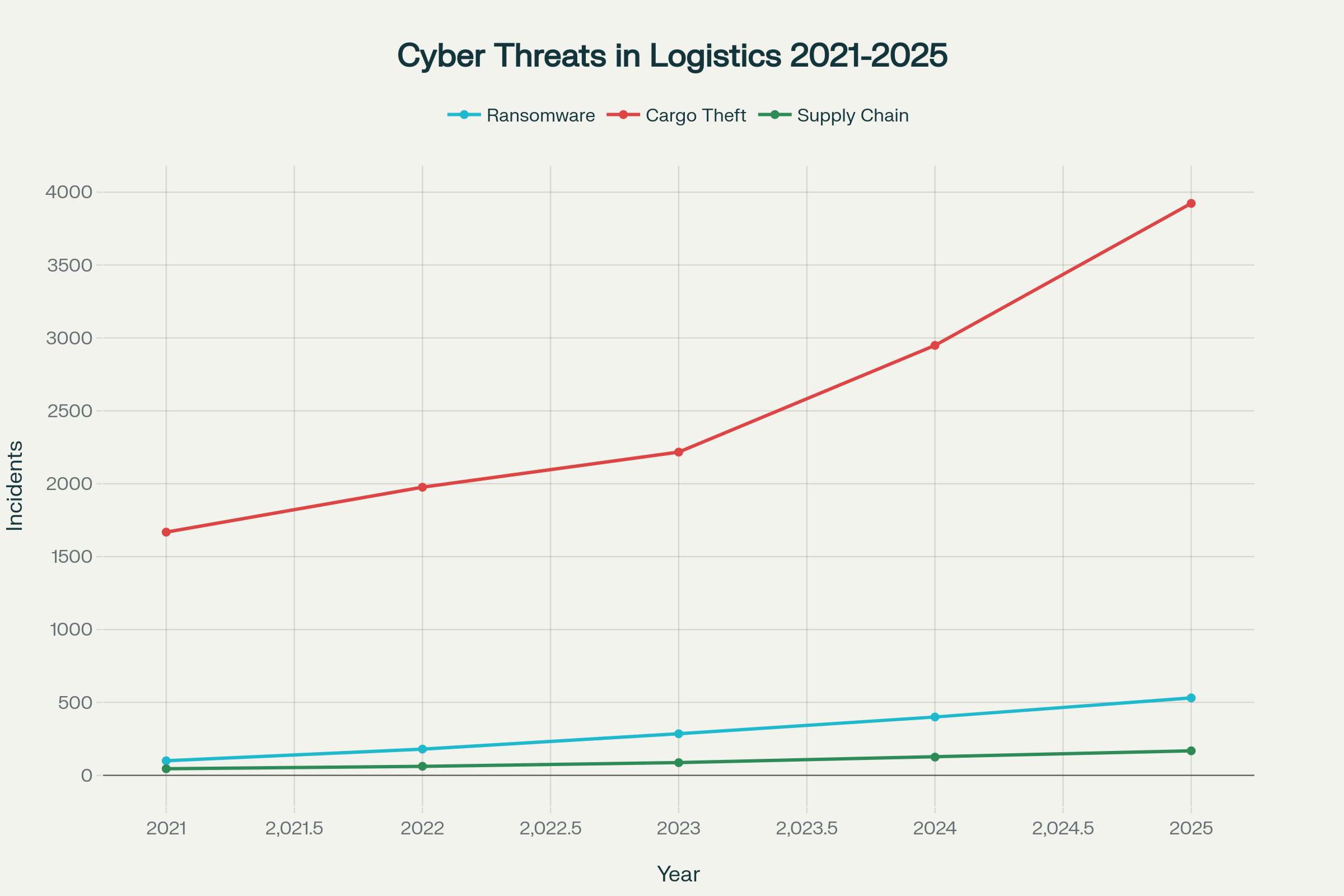
Rising Cyber Threats in Logistics Industry (2021-2025)
Modern supply chains represent some of the most vulnerable yet critical infrastructure in the global economy. Supply chain attacks now account for 35.5% of all data breaches, with 47% of organizations reporting experiencing a data breach linked to third-party network access. The logistics sector has become particularly attractive to cybercriminals due to its vast digital attack surface and cascading impact potential.
The scale of vulnerability is staggering. A typical distribution center contains hundreds of IP cameras, dozens of access control panels, barcode scanners, RFID readers, and automated sorting systems—all connected to the same network infrastructure that houses critical business systems. According to MIT's 2025 Warehouse Vulnerability Report, 60% of warehouses now use connected technology, with each facility averaging 200+ IoT devices. However, over 64% of these endpoints ship with default credentials and inadequate security protocols.
Recent incidents underscore the devastating impact of supply chain cyber attacks. KNP Logistics, a 150-year-old UK logistics company, completely collapsed following a ransomware attack by the Akira group, resulting in over 700 job losses. Forward Air suffered a $7.5 million revenue loss from a Hades ransomware attack that disrupted customs documentation and freight operations. The Port of Seattle endured nearly three weeks of operational disruptions from a Rhysida ransomware attack, forcing manual processing of over 7,000 disrupted baggage items.
The proliferation of Internet of Things devices in logistics operations has created an exponential increase in potential attack vectors. Each unsecured endpoint becomes a potential gateway for cybercriminals to infiltrate warehouse management systems, encrypt inventory databases, and halt operations across entire supply chains. Traditional cybersecurity approaches create dangerous blind spots by treating physical security infrastructure as separate from IT security, enabling sophisticated attack vectors.
Attackers increasingly use reconnaissance through video systems to map facility layouts, identify high-value targets, and monitor security personnel patterns before launching ransomware campaigns. Once inside the network through compromised cameras or sensors, threat actors pivot to critical systems, encrypting WMS databases and TMS platforms. During active incidents, cybercriminals often disable or manipulate video feeds to prevent visual verification of unauthorized access or asset theft.
Zero Trust Architecture fundamentally reimagines supply chain security by operating on the principle of "never trust, always verify". Unlike traditional perimeter-based security models, Zero Trust assumes that threats already exist within the network and requires continuous verification of every user, device, and transaction.
The National Institute of Standards and Technology (NIST) defines Zero Trust as systematically replacing implicit trust with calculated adaptive explicit trust based on identity and context. For supply chain operations, this means every camera, sensor, access control device, and IoT endpoint is treated as an active cybersecurity component rather than passive surveillance equipment.
Industry projections indicate that 60% of enterprises will transition to Zero Trust solutions by 2025, reflecting growing understanding that traditional security models cannot protect against modern supply chain threats. The convergence of physical and cyber security creates new opportunities for comprehensive threat protection that addresses both traditional security concerns and emerging cyber-physical threats.
Effective Zero Trust implementation in logistics requires identity-centric security that assigns verified identities to all warehouse operators, transportation managers, and vendor users. Role-Based Access Control (RBAC) ensures each function can reach only the systems and data necessary for logistics responsibilities, while continuous monitoring leverages AI tools to scan warehouse systems, fleet management platforms, and supplier portals.
Network micro-segmentation separates warehouses, transportation systems, IoT devices, and vendor portals into isolated zones, limiting attacker movement and reducing potential breach impact. This approach prevents lateral movement that has characterized many successful supply chain attacks, ensuring that even if one system is compromised, the impact remains localized to that specific resource.
TRASSIR fundamentally reimagines supply chain cybersecurity by treating every camera, sensor, and access control device as an active cybersecurity endpoint rather than passive surveillance equipment. This cyber-physical security integration (CPSI) methodology creates a unified defense architecture where physical security infrastructure actively contributes to cyber threat detection and response.
Unlike traditional video management systems that operate in isolation, TRASSIR VMS platform functions as a cybersecurity hub that correlates physical events with digital threat indicators. The platform's Linux-based hardened architecture eliminates common ransomware attack vectors while maintaining extensive hardware compatibility with 99% of existing IP cameras and security hardware.
Real-time bidirectional integration with SIEM platforms ensures that physical security events—such as unauthorized access attempts or unusual personnel movement patterns—immediately trigger cybersecurity alerts. Conversely, when IT security systems detect potential breaches, physical security resources automatically focus on relevant areas to provide visual verification and response capabilities.
TRASSIR's edge computing architecture processes video analytics and threat detection locally, reducing network bandwidth requirements while enabling sub-2-second response times for critical security events. This distributed processing model ensures continued protection even if network connectivity to central security operations centers becomes compromised during cyber attacks.
Proprietary neural networks trained specifically on logistics and warehouse environments deliver 95% accuracy in detecting suspicious behaviors that often precede cyber incidents. The system identifies unauthorized personnel in server rooms, unusual after-hours activity, and attempts to physically access network infrastructure, providing early warning capabilities that traditional cybersecurity tools cannot deliver.
TRASSIR ActiveStock revolutionizes warehouse investigation capabilities by synchronizing video footage with operational events in real-time. This groundbreaking system integrates directly with existing WMS platforms through robust APIs, creating seamless information flow between warehouse operations and security systems.
ActiveStock categorizes video content by warehouse scenarios, enabling instant searches by product, employee, document, or operational event. Investigation teams can locate specific incidents within minutes instead of spending 3-12 hours manually reviewing footage. The Arabesque Romania implementation across 21 warehouses achieved 30% reduction in security costs through this automated approach.
The system maintains synchronized offline and online modes, ensuring continuous operation even during network interruptions. Advanced search capabilities allow security teams to quickly identify patterns across multiple events, enabling proactive threat identification and operational optimization.
TRASSIR Face Recognition delivers 99.8% accuracy in personnel identification, providing military-grade security for sensitive warehouse areas. The system includes live face verification with anti-spoofing technology, preventing unauthorized access through photographs or video playback.
Advanced attribute-based search capabilities enable security teams to locate individuals based on age, gender, accessories, or other distinguishing characteristics. Database synchronization ensures real-time updates across all facility access points, maintaining consistent security protocols throughout complex warehouse environments.
The Cyber-Physical Access Correlation system maintains detailed audit trails that automatically link physical access events with network login activities. If an employee's credentials are used to access IT systems while their biometric data shows they're not physically present in the facility, automated alerts immediately flag potential credential compromise.
TRASSIR Neuro Detector eliminates the false alarm problem that plagues traditional motion detection systems, achieving 95%+ accuracy in distinguishing between authorized personnel, vehicles, and potential security threats. The technology recognizes humans, vehicles, and bicycles with exceptional precision, virtually eliminating false positives that waste security resources.
Neuro Detector AI analytics employs machine learning algorithms trained on over 1 million security scenarios to identify behavioral patterns that indicate reconnaissance activities, social engineering attempts, or other precursors to cyber attacks. The system's 95% accuracy rate in detecting suspicious behaviors enables security teams to intervene before threats escalate to full-scale incidents.
TRASSIR's comprehensive implementation at Saudi Logistics Services demonstrates how integrated video intelligence transforms large-scale warehouse operations. The deployment enhanced operational efficiency through automated vehicle tracking and optimized clearance processes. Real-time monitoring capabilities enabled faster turnaround times while maintaining strict security protocols.
The integration with existing operational systems provided seamless workflow integration without disrupting established procedures. Organizations implementing TRASSIR solutions report significant improvements in both cybersecurity posture and operational efficiency, with most warehouse implementations achieving return on investment within 12 months.
Organizations report 65% reductions in incident response times through automated correlation between physical and cyber events. False security alerts decrease by 40% due to AI-powered filtering and contextual analysis capabilities. Overall security operations costs decrease by 25% through centralized management and automated response workflows.
The prevention-focused approach delivers ROI through avoided incidents rather than recovered losses. Organizations implementing comprehensive enterprise security deployments report that cybersecurity insurance premiums decrease as insurers recognize the enhanced security posture provided by integrated physical-cyber security systems.
As supply chains become increasingly automated, cybersecurity approaches must evolve to match this complexity. 45% of supply chains will operate autonomously by 2035, requiring security systems that can protect unmanned facilities and respond to threats without human intervention.
TRASSIR's edge computing architecture and AI-powered analytics position organizations for this autonomous future. The platform's ability to process threats locally and trigger automated responses ensures continued protection even in lights-out warehouse operations or remote logistics facilities with limited connectivity.
Emerging regulations increasingly require organizations to demonstrate comprehensive cybersecurity controls that extend beyond traditional IT infrastructure. Physical security systems must meet the same security standards as other network-connected devices, creating compliance obligations that traditional video surveillance cannot address.
TRASSIR's cybersecurity-first architecture ensures that video management infrastructure meets enterprise security standards from deployment. Built-in encryption, access controls, and audit logging capabilities provide the documentation and controls required for regulatory compliance across multiple jurisdictions.
The logistics industry cannot afford to maintain reactive security approaches in the face of escalating threats and operational complexity. Traditional perimeter-based security models have proven inadequate against sophisticated threat actors who exploit the interconnected nature of modern supply chains. Supply chain cybersecurity requires a fundamental shift from treating physical and cyber security as separate disciplines to implementing unified defense architectures.
Zero Trust Architecture provides the framework for this transformation, assuming that threats already exist within the network and requiring continuous verification of every interaction. When combined with TRASSIR's proven cyber-physical security platform, organizations gain a comprehensive defense system that addresses both traditional cyber threats and the emerging risks facing modern supply chains.
The convergence of physical and cyber security creates new opportunities for comprehensive threat protection that traditional approaches cannot deliver. By transforming video surveillance infrastructure from passive monitoring into active cybersecurity components, organizations can significantly reduce their exposure to supply chain attacks while improving operational efficiency and regulatory compliance.
The escalating cyber threat landscape demands immediate action. Supply chain attacks will continue to increase in frequency and sophistication, targeting the path of least resistance through interconnected logistics networks. Organizations that fail to implement comprehensive Zero Trust architectures risk becoming the next headline in supply chain cybersecurity failures.
TRASSIR's proven cyber-physical security solutions provide the intelligence capabilities necessary to protect assets while optimizing operations. With over 500,000 deployed projects across 42+ countries, TRASSIR offers the global expertise and technological sophistication required to secure modern supply chain operations.
Contact TRASSIR's cybersecurity specialists for a comprehensive facility assessment and live demonstration of cyber-physical security integration in action. Discover how leading organizations are reducing ransomware risks while improving operational visibility across their entire supply chain infrastructure. The future of supply chain security is here—ensure your organization is prepared.
Articles
All articles
The Complete Guide to Retail Crowd Density Monitoring Using Video Analytics
The Complete Guide to Retail Crowd Density Monitoring Using Video Analytics

The Ultimate Guide to Occupancy Tracking Technology: Systems, Sensors, and Strategy
The Ultimate Guide to Occupancy Tracking Technology: Systems, Sensors, and Strategy
Maximizing Retail Performance: The Ultimate Guide to Heat Mapping Technology
Maximizing Retail Performance: The Ultimate Guide to Heat Mapping Technology
The Complete Guide to Deploying AI Video Analytics in Retail and Enterprise
The Complete Guide to Deploying AI Video Analytics in Retail and Enterprise

How to Design a Scalable Video Surveillance System for Multi-Site Retail
How to Design a Scalable Video Surveillance System for Multi-Site Retail

Upgrading Legacy CCTV: How to Integrate AI Without a Rip-and-Replace
Upgrading Legacy CCTV: How to Integrate AI Without a Rip-and-Replace

Upgrading Legacy CCTV: The Complete Guide to AI Security Camera Integration
Upgrading Legacy CCTV: The Complete Guide to AI Security Camera Integration
The Evolution of Video Analytics: How AI Transforms Security and Operations
The Evolution of Video Analytics: How AI Transforms Security and Operations

How AI Video Surveillance Solves Security Staffing Shortages and Reduces Costs
How AI Video Surveillance Solves Security Staffing Shortages and Reduces Costs

Maximizing Security System ROI: The Financial Case for Smart Surveillance
Maximizing Security System ROI: The Financial Case for Smart Surveillance

How to Calculate the ROI of a Business Security System
How to Calculate the ROI of a Business Security System
Master Multi-Brand CCTV Management: The Ultimate Guide to Brand-Agnostic Surveillance
Master Multi-Brand CCTV Management: The Ultimate Guide to Brand-Agnostic Surveillance

Strategic Guide to Retail Video Surveillance Migration: Upgrading Legacy Systems
Strategic Guide to Retail Video Surveillance Migration: Upgrading Legacy Systems

How to Reduce Commercial Security Costs Without Compromising Protection
How to Reduce Commercial Security Costs Without Compromising Protection

How to Reduce Retail Operational Costs With Video Analytics
How to Reduce Retail Operational Costs With Video Analytics
Security Staffing Optimization: The Complete 2026 Guide
Security Staffing Optimization: The Complete 2026 Guide

AI Retail Theft Prevention: How Smart Cameras Stop Shrinkage
AI Retail Theft Prevention: How Smart Cameras Stop Shrinkage

Modern Shopping Center Security Systems: The Complete Guide
Modern Shopping Center Security Systems: The Complete Guide
Video Management Systems Explained: Features, Benefits, and How to Choose the Right VMS
Video Management Systems Explained: Features, Benefits, and How to Choose the Right VMS

The Reality of the Single Pane of Glass: Achieving Unified IT Visibility
The Reality of the Single Pane of Glass: Achieving Unified IT Visibility
Try TRASSIR For Your Business
Learn more about how TRASSIR analytic modules work! Demo mode is an opportunity to see for yourself how the system works, and also check the interface and test all the functions.Success!
We will contact you as soon as possible