




Predictive Analytics for Warehouse Safety: Reducing Accidents with AI
The logistics industry stands at a critical juncture where traditional safety approaches can no longer adequately protect workers in increasingly complex warehouse environments. With warehouse injury rates reaching 5.5 cases per 100 employees annually—more than double the private industry average of 2.7—the need for proactive, intelligent safety solutions has never been more urgent. TRASSIR's AI-powered predictive analytics platform emerges as a transformative solution, enabling logistics operators to shift from reactive incident response to predictive accident prevention, delivering measurable reductions in workplace injuries while optimizing operational efficiency.
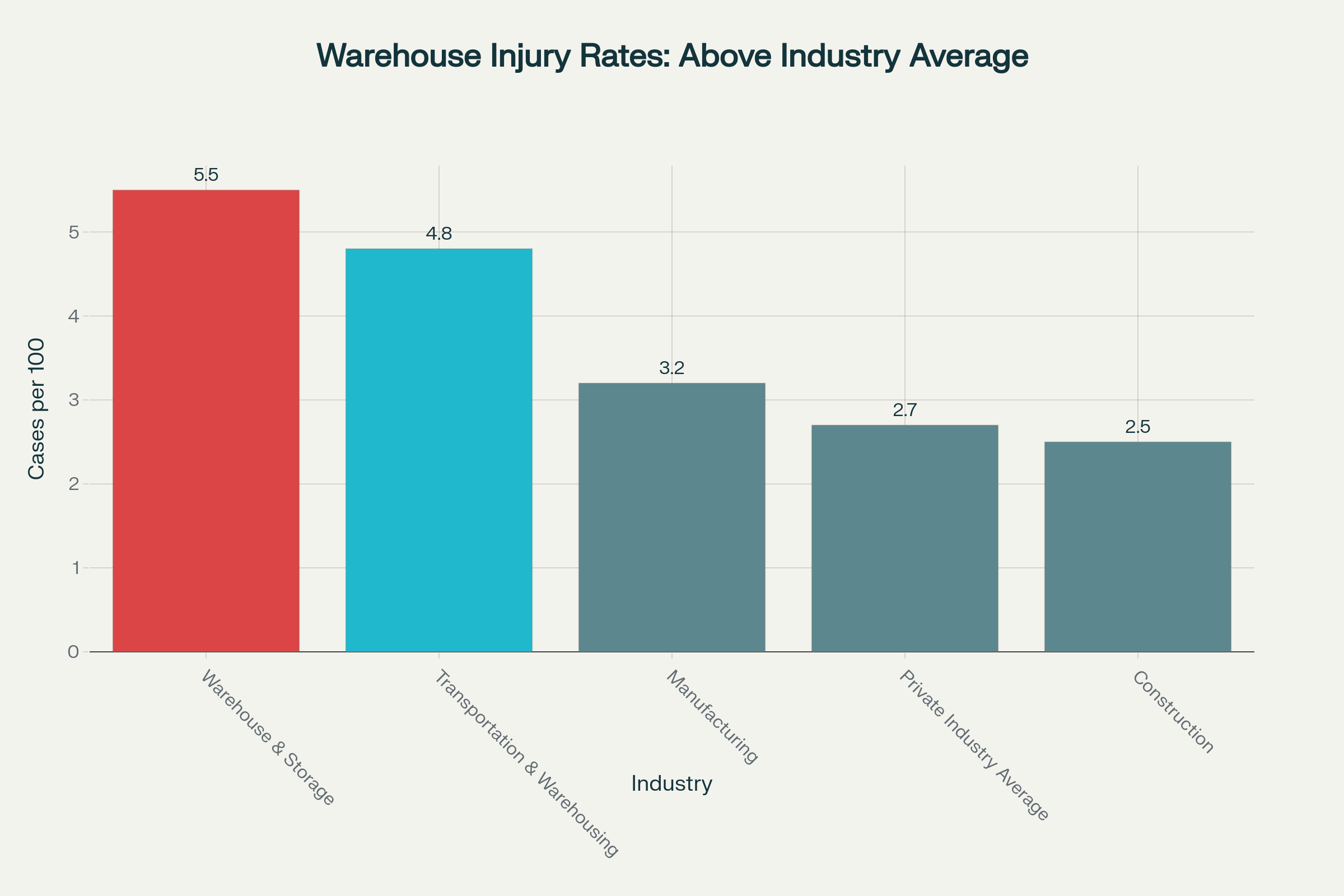
Warehouse safety challenges: Injury rates significantly exceed industry averages, highlighting the critical need for predictive analytics solutions
Modern warehouse operations face unprecedented safety challenges that traditional surveillance and manual oversight systems cannot effectively address. The logistics sector experiences unique vulnerabilities due to high-value inventory concentration, complex access requirements, 24/7 operational demands, and the integration of human workers with increasingly automated systems.
Recent OSHA data reveals alarming trends in warehouse safety incidents. The warehouse sector reports 5.5 safety incidents per 100 employees annually, compared to the 2.7 per 100 rate across all industries. This represents nearly a 100% increase over the general industry baseline, making warehousing one of the most dangerous work environments in the United States.
Transportation and warehousing combined recorded a rate of 4.8 cases per 100 full-time workers in 2022, with specific incident categories including:
The most common warehouse safety incidents include forklift and vehicle collisions (35,000-62,000 injuries annually), slips and falls (representing nearly 50% of all warehouse injuries), struck-by incidents involving falling objects, and repetitive stress injuries from manual material handling.
Cargo theft has reached crisis levels, with 2,217 reported incidents in 2024 representing a 49% increase from 2023. The average cargo theft incident now costs businesses $202,000, while organized crime groups increasingly target high-value commodities stored in distribution centers. However, safety incidents impose even greater costs through direct medical expenses, workers' compensation claims, productivity losses, and regulatory penalties.
Manual investigation processes consume 3-12 hours per incident, creating costly delays and incomplete evidence trails. Legacy surveillance systems operate in isolation from warehouse management systems (WMS), creating dangerous operational blind spots where security teams cannot correlate video footage with inventory movements or operational events.
Predictive analytics represents a fundamental shift from reactive safety management to proactive risk prevention. By leveraging artificial intelligence, machine learning algorithms, and real-time data analysis, predictive safety systems can forecast workplace injuries with up to 97% accuracy when provided with four years of safety data.
Data Collection and Integration: Predictive analytics platforms gather information from multiple sources including incident reports, safety audits, equipment sensors, environmental monitoring systems, and video surveillance feeds. This comprehensive data integration provides the foundation for accurate pattern recognition and risk assessment.
Pattern Analysis and Machine Learning: Advanced AI algorithms analyze historical data to identify patterns and trends that precede safety incidents. These systems can recognize subtle behavioral indicators, environmental conditions, and operational factors that increase accident probability.
Real-Time Risk Assessment: Modern predictive systems process incoming data streams in real-time, continuously updating risk assessments and triggering alerts when dangerous conditions develop. This enables immediate intervention before incidents occur.
Automated Response Protocols: When high-risk situations are detected, predictive systems automatically initiate response protocols including supervisor notifications, equipment shutdowns, access restrictions, and emergency procedure activation.
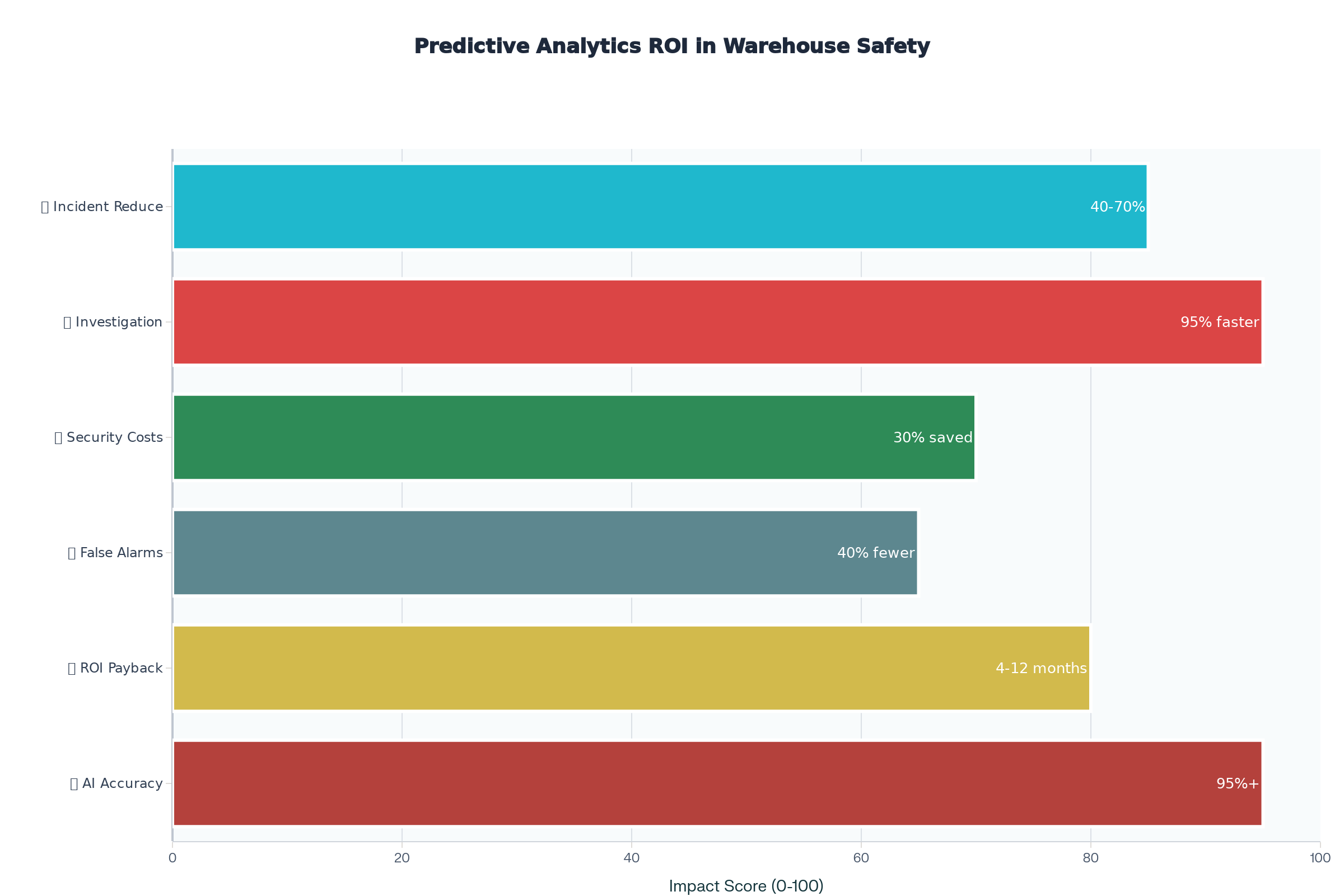
Organizations implementing predictive analytics for workplace safety report significant measurable improvements. Companies using AI-driven predictive analytics have achieved 40-70% reductions in workplace accidents, with some manufacturing plants saving over $2 million in operational disruptions through proactive incident prevention.
The return on investment typically manifests through several channels:
TRASSIR, the global leader in intelligent video management with over 500,000 deployed projects across 42+ countries, transforms warehouse security through event-driven video intelligence that goes far beyond traditional surveillance capabilities. The company's integrated platform approach synchronizes every warehouse operation with corresponding video evidence, creating a unified operational control system that enables predictive safety management.
TRASSIR's platform utilizes proprietary neural networks trained specifically on logistics and warehouse environments, delivering 95% accuracy in detecting suspicious behaviors and safety violations. The system's machine learning algorithms continuously improve detection capabilities, adapting to each facility's unique operational characteristics and threat profiles.
The platform provides 99% compatibility with existing camera infrastructure, eliminating costly hardware replacements while enabling advanced AI capabilities. This universal compatibility allows warehouses to upgrade their intelligence capabilities without disrupting current operations, making implementation both cost-effective and operationally seamless.
TRASSIR Neuro Detector serves as the foundation of the safety monitoring system, eliminating false alarm problems that plague traditional motion detection systems. Using advanced neural networks, the system achieves 95%+ accuracy in distinguishing between authorized personnel, vehicles, and potential security threats.
The technology recognizes humans, vehicles, and bicycles with exceptional precision, virtually eliminating false positives that waste security resources. This accuracy improvement allows warehouses to implement automated alert systems without overwhelming security teams with irrelevant notifications.
TRASSIR Face Recognition delivers 99.8% accuracy in personnel identification, providing military-grade security for sensitive warehouse areas. The system includes live face verification with anti-spoofing technology, preventing unauthorized access through photographs or video playback. Advanced attribute-based search capabilities enable security teams to locate individuals based on age, gender, accessories, or other distinguishing characteristics.
Specialized Safety Modules address specific warehouse hazards through targeted monitoring capabilities:
TRASSIR ActiveStock revolutionizes warehouse investigation capabilities by synchronizing video footage with operational events in real-time. This groundbreaking system integrates directly with existing WMS platforms through robust APIs, creating seamless information flow between warehouse operations and security systems.
ActiveStock categorizes video content by warehouse scenarios, enabling instant searches by product, employee, document, or operational event. Investigation teams can locate specific incidents within minutes instead of spending 3-12 hours manually reviewing footage. The system maintains synchronized offline and online modes, ensuring continuous operation even during network interruptions.
TRASSIR implementations consistently deliver quantifiable improvements in security effectiveness and operational efficiency across diverse warehouse environments. Real-world deployments demonstrate the transformative potential of AI-powered predictive analytics in enhancing workplace safety.
The Arabesque Romania deployment across 21 warehouses achieved a 30% reduction in security costs through automated access control and streamlined investigation processes. The system's ability to quickly locate and analyze security events eliminated the need for extensive manual investigation resources, while proactive threat identification prevented incidents before they could impact operations.
Saudi Logistics Services implemented TRASSIR's comprehensive video intelligence platform to enhance operational efficiency through automated vehicle tracking and optimized clearance processes. Real-time monitoring capabilities enabled faster turnaround times while maintaining strict security protocols, with the integration providing seamless workflow integration without disrupting established procedures.
A large logistics company deployment of AI-based video analytics led to a 40% reduction in minor safety incidents within just one quarter of implementation. This dramatic improvement resulted from real-time hazard detection that prevented injuries before they occurred by flagging behaviors such as pallet overstacking, unsafe lifting angles, and fatigue-induced navigation errors.
Most warehouse implementations achieve return on investment within 12 months, with some facilities reporting payback periods as short as 4-6 months. These rapid ROI achievements result from multiple value streams:
McKinsey research indicates that implementing automation in logistics can reduce workplace injuries by up to 70%. Companies investing in warehouse robotics and AI surveillance report not only increased productivity but also noticeable improvements in occupational safety levels, creating a virtuous cycle of enhanced worker protection and operational excellence.
The logistics industry's diverse operational requirements demand tailored approaches to predictive safety implementation. TRASSIR's modular platform architecture enables customized deployments that address specific warehouse types and operational challenges.
Warehouses handling high-value commodities face increased security risks that traditional systems cannot adequately address. TRASSIR's integrated approach combines physical security monitoring with operational intelligence, enabling comprehensive protection strategies that prevent both external theft and internal losses.
The platform's ability to correlate physical access events with network login activities ensures that biometric authentication cannot be circumvented through credential compromise. If an employee's credentials are used to access IT systems while their biometric data shows they're not physically present in the facility, automated alerts immediately flag potential security breaches.
Temperature-controlled environments present unique safety challenges that require specialized monitoring capabilities. TRASSIR's environmental monitoring integration tracks temperature, humidity, and material sensitivity in real-time, providing critical oversight for perishable goods storage and worker safety in extreme conditions.
Wearable IoT integration enables continuous monitoring of worker vital signs in challenging environments, automatically triggering alerts when physiological indicators suggest heat stress, hypothermia, or other environmental hazards. This predictive capability is especially valuable for preventing temperature-related incidents in cold storage facilities.
Large logistics operations spanning multiple facilities require centralized management capabilities that maintain consistent safety standards across diverse locations. TRASSIR's distributed architecture supports enterprise-scale deployments with centralized monitoring and management capabilities.
The platform's cloud integration enables real-time data sharing between facilities, allowing safety managers to identify patterns and implement improvements across entire logistics networks. This enterprise approach ensures that safety innovations developed at one facility can be rapidly deployed across all operations.
Successful predictive analytics deployment requires careful planning and phased implementation that aligns with operational requirements and organizational capabilities. TRASSIR's proven deployment methodology ensures smooth integration and rapid value realization.
Comprehensive facility assessment forms the foundation of effective predictive analytics implementation. TRASSIR's logistics specialists conduct detailed evaluations of existing infrastructure, operational workflows, and safety challenge areas to design optimal system configurations.
This assessment phase includes camera coverage analysis, network infrastructure evaluation, integration requirements with existing WMS and security systems, and identification of high-risk operational areas requiring prioritized monitoring.
Most companies begin seeing ROI in predictable phases:
This phased approach allows organizations to validate system effectiveness while gradually expanding coverage and capabilities across the entire facility.
Successful implementation requires comprehensive staff training and change management to ensure maximum adoption and effectiveness. TRASSIR provides detailed training programs that cover system operation, alert response protocols, and data interpretation for safety managers.
Employee engagement is crucial for predictive analytics success, as frontline workers provide essential data through safety reporting and compliance with monitoring protocols. Organizations that establish clear communication about system benefits and privacy protections achieve higher compliance rates and more effective safety outcomes.
The convergence of artificial intelligence, IoT sensors, and advanced analytics is creating unprecedented opportunities for proactive safety management in warehouse environments. Future warehouse operations will depend increasingly on predictive analytics and automated response capabilities.
Advanced sensor fusion will enable more comprehensive environmental monitoring, combining video analytics with atmospheric sensors, vibration monitoring, and wearable device data to create complete situational awareness. This integration will provide earlier warning of developing safety hazards and more accurate risk assessment capabilities.
Natural language processing integration will enable voice-activated safety reporting and automated incident documentation, reducing administrative burden while improving data quality for predictive modeling. Workers will be able to report near-miss events and safety concerns through simple voice commands, ensuring comprehensive data collection.
OSHA's five-year plan to reduce warehouse injuries emphasizes the importance of proactive safety technologies in meeting evolving regulatory requirements. Organizations implementing comprehensive predictive analytics platforms position themselves favorably for future compliance obligations while demonstrating commitment to worker safety.
The integration of predictive analytics with regulatory reporting systems will streamline compliance documentation and provide objective evidence of safety program effectiveness during regulatory inspections.
45% of supply chains will operate autonomously by 2035, requiring security systems that can protect unmanned facilities and respond to threats without human intervention. TRASSIR's edge computing architecture and AI-powered analytics position organizations for this autonomous future through local threat processing and automated response capabilities.
The shift toward predictive safety management represents more than technological advancement; it signifies a fundamental transformation in how the logistics industry approaches worker protection and operational excellence.
The logistics industry cannot afford to maintain reactive safety approaches in the face of escalating operational complexity and regulatory requirements. TRASSIR's proven AI-powered predictive analytics solutions provide the intelligence capabilities necessary to protect workers while optimizing operations, delivering measurable returns on investment through reduced incidents, improved efficiency, and enhanced compliance.
The compelling business case for predictive analytics implementation includes:
The convergence of physical and cyber security creates new opportunities for comprehensive threat protection that extends beyond traditional safety concerns. TRASSIR's integrated approach addresses both conventional security challenges and emerging cyber-physical threats that target warehouse operations through connected systems.
Organizations implementing comprehensive predictive analytics platforms gain competitive advantages through enhanced operational visibility, reduced risk exposure, and improved regulatory compliance capabilities. This strategic investment in worker safety and operational intelligence transforms surveillance from a cost center into a strategic operational asset that drives continuous improvement and sustainable competitive advantage.
The transformation from reactive to predictive safety management is not optional for forward-thinking logistics organizations—it is essential for sustainable operations in an increasingly complex and regulated environment. TRASSIR's comprehensive platform provides the technological foundation necessary to achieve safety excellence while optimizing operational performance across all aspects of warehouse management.
For logistics leaders committed to protecting their workforce while maximizing operational efficiency, TRASSIR's predictive analytics platform offers a proven pathway to safety transformation. The combination of advanced AI technology, comprehensive integration capabilities, and demonstrated ROI makes predictive safety analytics an essential investment for any serious warehouse operation focused on long-term success and worker protection.
Articles
All articles
The Complete Guide to Retail Crowd Density Monitoring Using Video Analytics
The Complete Guide to Retail Crowd Density Monitoring Using Video Analytics

The Ultimate Guide to Occupancy Tracking Technology: Systems, Sensors, and Strategy
The Ultimate Guide to Occupancy Tracking Technology: Systems, Sensors, and Strategy
Maximizing Retail Performance: The Ultimate Guide to Heat Mapping Technology
Maximizing Retail Performance: The Ultimate Guide to Heat Mapping Technology

The Complete Guide to Deploying AI Video Analytics in Retail and Enterprise
The Complete Guide to Deploying AI Video Analytics in Retail and Enterprise

How to Design a Scalable Video Surveillance System for Multi-Site Retail
How to Design a Scalable Video Surveillance System for Multi-Site Retail

Upgrading Legacy CCTV: How to Integrate AI Without a Rip-and-Replace
Upgrading Legacy CCTV: How to Integrate AI Without a Rip-and-Replace

Upgrading Legacy CCTV: The Complete Guide to AI Security Camera Integration
Upgrading Legacy CCTV: The Complete Guide to AI Security Camera Integration
The Evolution of Video Analytics: How AI Transforms Security and Operations
The Evolution of Video Analytics: How AI Transforms Security and Operations

How AI Video Surveillance Solves Security Staffing Shortages and Reduces Costs
How AI Video Surveillance Solves Security Staffing Shortages and Reduces Costs

Maximizing Security System ROI: The Financial Case for Smart Surveillance
Maximizing Security System ROI: The Financial Case for Smart Surveillance

How to Calculate the ROI of a Business Security System
How to Calculate the ROI of a Business Security System

Master Multi-Brand CCTV Management: The Ultimate Guide to Brand-Agnostic Surveillance
Master Multi-Brand CCTV Management: The Ultimate Guide to Brand-Agnostic Surveillance

Strategic Guide to Retail Video Surveillance Migration: Upgrading Legacy Systems
Strategic Guide to Retail Video Surveillance Migration: Upgrading Legacy Systems

How to Reduce Commercial Security Costs Without Compromising Protection
How to Reduce Commercial Security Costs Without Compromising Protection

How to Reduce Retail Operational Costs With Video Analytics
How to Reduce Retail Operational Costs With Video Analytics

Security Staffing Optimization: The Complete 2026 Guide
Security Staffing Optimization: The Complete 2026 Guide

AI Retail Theft Prevention: How Smart Cameras Stop Shrinkage
AI Retail Theft Prevention: How Smart Cameras Stop Shrinkage

Modern Shopping Center Security Systems: The Complete Guide
Modern Shopping Center Security Systems: The Complete Guide

Video Management Systems Explained: Features, Benefits, and How to Choose the Right VMS
Video Management Systems Explained: Features, Benefits, and How to Choose the Right VMS

The Reality of the Single Pane of Glass: Achieving Unified IT Visibility
The Reality of the Single Pane of Glass: Achieving Unified IT Visibility
Try TRASSIR For Your Business
Learn more about how TRASSIR analytic modules work! Demo mode is an opportunity to see for yourself how the system works, and also check the interface and test all the functions.Success!
We will contact you as soon as possible