The Inefficiencies of Fragmented Security
Operating a multi-site enterprise with decentralized security creates immediate logistical hurdles. When security systems are isolated to individual locations, administrators must juggle different software interfaces, manage disparate vendor contracts, and physically travel to sites to review footage or resolve issues. This fragmentation limits visibility and drastically slows down emergency response times. If an alarm triggers at a remote facility after hours, relying on local-only alerts means corporate oversight is effectively blind until an on-site manager intervenes.
Furthermore, legacy on-premises systems frequently suffer from compatibility issues and inconsistent hardware standards. One store might use high-definition digital cameras, while another relies on outdated analog equipment, making enterprise-wide policy enforcement nearly impossible. These inconsistencies elevate the risk of internal theft, liability claims, and prolonged downtime when equipment fails without notifying the central network. Centralizing these operations eliminates the guesswork, allowing a single team to monitor the entire organizational footprint simultaneously.
Core Pillars of a Centralized Security Network
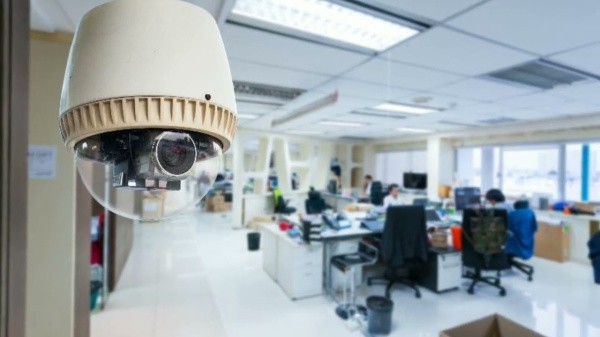
A robust multi-location security strategy relies on integrating several distinct technologies into a single, unified dashboard. The foundational pillar is the video surveillance system, which acts as the eyes of the operation across all properties. Instead of logging into separate network video recorders, administrators can view live and recorded feeds from every site through a central interface. This visibility is paired with centralized access control systems, enabling security teams to instantly grant or revoke building credentials, mobile access, or keycard permissions from anywhere in the world.
Alarms and intrusion detection sensors form the third critical pillar. When physical sensors are connected to the central network, a breached door or broken window instantly triggers a universal alert. The most effective platforms link these alarms directly to the surveillance feeds, automatically pulling up the corresponding camera view when a sensor is tripped. For locations requiring visitor oversight, digitized guest management systems can seamlessly issue temporary, restricted access badges that expire automatically, ensuring a complete audit trail of everyone entering and exiting the facilities.
Selecting the Right Infrastructure Architecture
The backbone of any centralized security system is its data architecture, which dictates how footage and alerts are stored, transmitted, and accessed. A fully cloud-based architecture stores all data on remote servers, offering unparalleled accessibility and ease of scaling when adding new business locations. However, this model requires significant and consistent internet bandwidth; streaming dozens of high-definition camera feeds continuously can easily overwhelm a location's local network.
Conversely, an on-premises architecture processes and stores all data locally at each site. While this protects against internet outages and sidesteps ongoing cloud storage fees, it severely complicates remote access and requires costly local hardware upgrades. The most practical solution for multi-site organizations is often a hybrid architecture. Hybrid systems record high-resolution video onto local edge devices but utilize cloud connections for remote dashboard management, sending only critical alerts or motion-triggered clips to the cloud. This ensures uninterrupted local recording while minimizing bandwidth consumption and maintaining centralized oversight.
Enhancing Oversight with Video AI and Integrations
Modern surveillance has evolved past passive recording, utilizing artificial intelligence to actively monitor environments and flag anomalies. Video AI transforms cameras into proactive tools by analyzing live feeds for specific risks, such as loitering in restricted areas, unexpectedly long checkout queues, or after-hours motion. By automating detection, security teams no longer need to manually watch hours of empty footage, allowing them to focus entirely on verifying and responding to system-generated alerts. Advanced attribute-based search capabilities further accelerate investigations by allowing users to instantly filter footage across all sites for specific criteria, like vehicle types or clothing colors.
Point-of-sale integration is another transformative capability for retail and franchise operations. Exception-based reporting links transaction data directly to video timestamps. If a register processes an unusually high number of voids, refunds, or no-sale drawer opens, the system flags the activity and attaches the corresponding video clip. This allows investigators to immediately verify if a customer was present during a refund, drastically reducing the time required to identify and address internal theft and operational shrink.
Protecting the Network: Cybersecurity and Compliance
As physical security systems become deeply integrated with corporate IT networks, safeguarding the surveillance data itself is paramount. A centralized system must employ end-to-end encryption to protect video streams both in transit and at rest, ensuring that intercepted data remains unreadable. Utilizing virtual private networks guarantees that remote communications between branches and the central hub occur within secure, isolated digital tunnels.
Administrators must also implement strict role-based access control. This ensures that local managers only have access to their specific branch's cameras, while regional directors can view their designated territories, and executive teams maintain global access. Adhering to regulatory frameworks is equally critical; organizations must ensure their chosen hardware and cloud providers meet industry standards, such as SOC 2 Type II for cloud security, PCI DSS 4.0 for payment environments, and relevant privacy laws dictating employee and consumer surveillance.
Best Practices for Deployment and Scaling
Successfully rolling out a multi-site security overhaul requires meticulous planning to avoid disrupting daily operations. The process must begin with comprehensive site audits to catalog existing hardware, identify blind spots, and measure local bandwidth capacities. Organizations do not necessarily need to replace all legacy equipment; utilizing industry standards like ONVIF protocols allows modern cloud platforms to integrate smoothly with older IP cameras, preserving initial hardware investments.
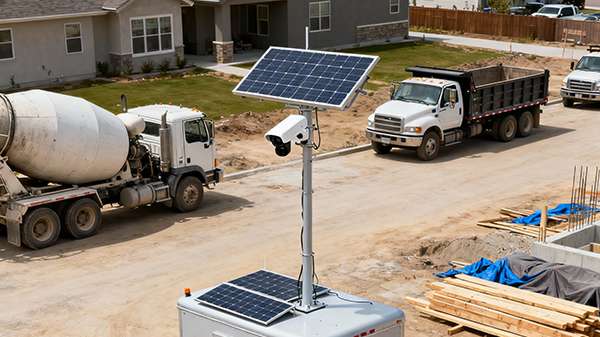
Rather than attempting a simultaneous enterprise-wide launch, implementing the technology through a phased rollout minimizes risk. Deploying the system at a handful of pilot locations allows teams to test network strain, refine AI detection sensitivities, and finalize training materials before expanding. For off-grid environments like construction sites or remote facilities, managers can integrate self-sustaining mobile surveillance units powered by solar panels and connected via cellular networks, seamlessly bringing even temporary locations into the centralized fold.
Transitioning to a centralized, multi-site security strategy fundamentally changes how an organization protects its people, assets, and bottom line. By breaking down information silos and uniting video, access control, and analytics under a single digital roof, businesses can move from reactive damage control to proactive risk management. Ultimately, a properly architected security network not only deters threats but drives enterprise-wide operational efficiency, proving its value well beyond basic surveillance.
Key Takeaways:
Centralized dashboards eliminate the need to physically travel between locations or juggle multiple software logins to verify security incidents.
Hybrid architectures offer the most balanced approach, keeping high-resolution recording local while using the cloud for low-bandwidth remote management.
Integrating point-of-sale data with video surveillance provides immediate visual context for high-risk transactions, streamlining internal theft investigations.
Embracing open standards like ONVIF allows businesses to integrate legacy cameras into modern platforms, avoiding expensive total hardware replacements.
Protecting surveillance networks requires strict role-based access control, end-to-end encryption, and compliance with data privacy frameworks.
FAQ:
Q: What happens to a centralized security system if a location loses its internet connection?
A: In a hybrid architecture, local edge devices continue recording and storing high-resolution footage locally during an outage, uploading the data to the central cloud once connectivity is restored.
Q: Do I need to replace all my existing cameras to implement centralized management?
A: No, modern centralized platforms are typically camera-agnostic and use industry standards to integrate with your existing IP cameras, drastically reducing deployment costs.
Q: How much upload bandwidth does a multi-site surveillance system require?
A: Standard HD cameras generally require 2-4 Mbps of upload speed per stream, though hybrid systems reduce this burden by only sending motion-triggered alerts or compressed streams to the cloud.
Q: How does artificial intelligence improve multi-location security?
A: AI automates monitoring by analyzing live feeds for predefined risks—such as loitering or unauthorized entry—and instantly alerting security teams, eliminating the need for manual observation.